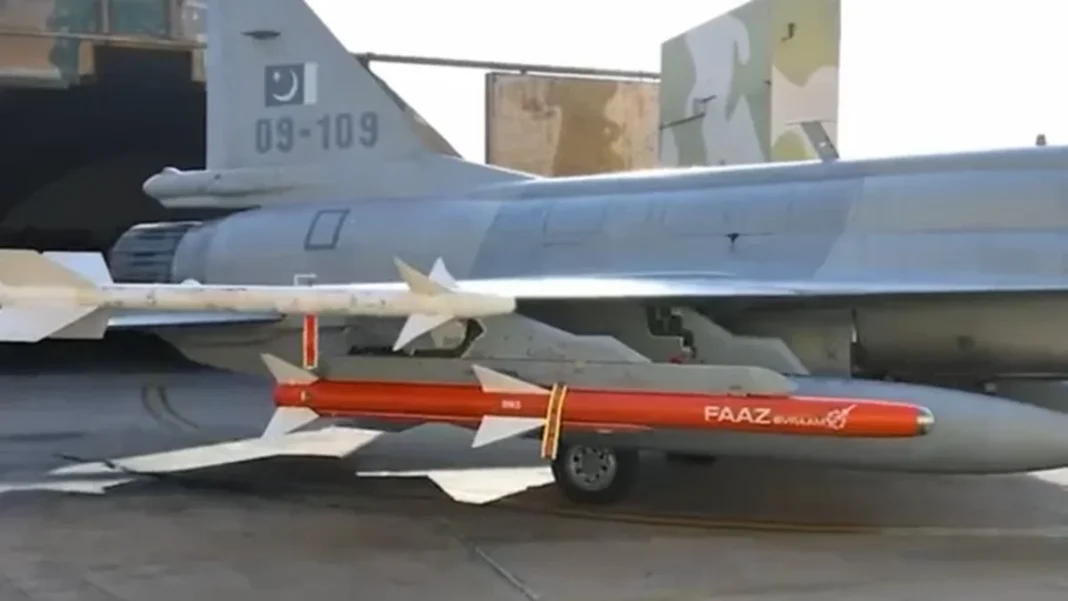
Pakistan Tests First Home-Made Faaz Air-to-Air Missile
Pakistan has successfully flight-tested the Faaz air-to-air missile, its first indigenously developed weapon of its kind, the military’s media wing said on Tuesday. The test marks a new step for the country’s defence industry, which has until now publicised ground-launched systems far more often than air-launched ones.
The Inter-Services Public Relations (ISPR) said the missile carries an advanced terminal guidance system. It can engage enemy aerial targets at longer ranges, the statement said. Senior officers of the armed forces watched the launch, along with the scientists and engineers who developed the weapon.
“Faaz will significantly enhance the operational flexibility of the Pakistan Air Force, further strengthening the country’s overall defence posture,” the ISPR statement said. It added that the test showed the “technical maturity, innovation and self-reliance” achieved by Pakistan’s defence industry.
The president, the prime minister, the chief of army staff and chief of defence forces, and the services chiefs congratulated the scientists and engineers. Interior Minister Mohsin Naqvi also congratulated the nation, and said Pakistanis were proud of their scientists and engineers.
Faaz air-to-air missile: what the test confirms
An air-to-air missile is fired from an aircraft against another aircraft. That sets Faaz apart from the systems Pakistan has tested in recent weeks. Earlier this month, the army test-fired an extended-range version of the Fatah-2 hypersonic ballistic missile. A week before that announcement, an extended version of the Fatah-4 ground-launched cruise missile was also tested.
Both Fatah systems are ground-launched. They are built to strike targets on land at extended ranges with high precision. Faaz, by contrast, is carried by a fighter aircraft and aimed at targets in the air. The ISPR statement did not give a range figure for Faaz, and it did not name the aircraft used in the test. A photograph released with the announcement shows an orange missile marked Faaz fitted under a Pakistan Air Force fighter jet.
The terminal guidance system is the part of the weapon that steers it in the final stage of flight. The ISPR described it as state of the art, but it gave no further technical detail. No independent verification of the test was available on Tuesday evening, and the announcement rests on the ISPR statement and the released photograph.
Why an air-to-air weapon matters for Pakistan
Air-to-air capability shapes how an air force can defend its own airspace. A fighter that can engage an intruder from a longer range can act before a threat reaches its target. It can also protect strike aircraft and support missions over a wider area. For Pakistan, whose air force operates along two active frontiers, that flexibility has direct operational value.
The test also fits a wider pattern in Pakistan’s recent missile programme. The Fatah-2 test showed work on hypersonic flight, advanced navigation and modern avionics. The Fatah-4 test showed work on cruise-missile accuracy and the ability to defeat enemy missile defences. Faaz adds a third strand, which is the ability to fight in the air rather than strike from the ground.
That sequence matters for readers following the region’s security picture. Pakistan’s operations in Balochistan this month, covered in Feature Pakistan’s report on the 17 killed in Balochistan operations, have focused on ground threats. The Faaz test points in a different direction, towards air defence and air combat. It also lands at a time of sharp regional tension, as Washington has signalled progress in talks with Iran aimed at averting a fresh flare-up, covered in the live post on US signals progress in Iran talks.
What remains unknown about Faaz
Several key facts are still missing from the public record. The ISPR did not say where the test took place, or when exactly it was carried out. It did not state the missile’s range, speed, or warhead weight. It also did not say when Faaz will enter service with the Pakistan Air Force, or how many units are planned.
Those gaps are normal for a first announcement of this kind. Missile programmes are usually revealed in stages, with specifications following only after induction. Until then, the confirmed facts are narrow: a first flight test has taken place, the weapon is home-made, it uses terminal guidance, and it is meant to engage aerial targets at longer ranges.
The test will now be watched for follow-up signs. A second test, a formal induction ceremony, or a display at a military parade would each show the programme moving from development to service. For now, Faaz stands as Pakistan’s first declared home-made air-to-air missile, and as the latest sign of a defence industry that is widening its range of weapons.
Frequently asked questions
What is the Faaz missile?
Faaz is Pakistan’s first indigenously developed air-to-air missile. It is fired from an aircraft against aerial targets, and it uses an advanced terminal guidance system.
Who announced the Faaz test?
The Inter-Services Public Relations (ISPR), the military’s media wing, announced the successful flight test on Tuesday, 3 November 2026.
What can Faaz hit?
According to the ISPR, Faaz can engage enemy aerial targets at longer ranges. No specific range figure has been released.
How is Faaz different from Fatah-2 and Fatah-4?
Fatah-2 and Fatah-4 are ground-launched systems built to strike land targets. Faaz is air-launched and built to fight other aircraft in the air.
When will Faaz enter service?
That has not been announced. The ISPR has not given an induction date, a production figure, or full specifications for the missile.