Fazl Residence Meeting Unites Opposition on KP Rule
A Fazl residence meeting has brought Pakistan’s opposition parties together for the first time since governor’s rule and an emergency were imposed in Khyber-Pakhtunkhwa, with leaders agreeing to build a joint response to the province’s new political order.
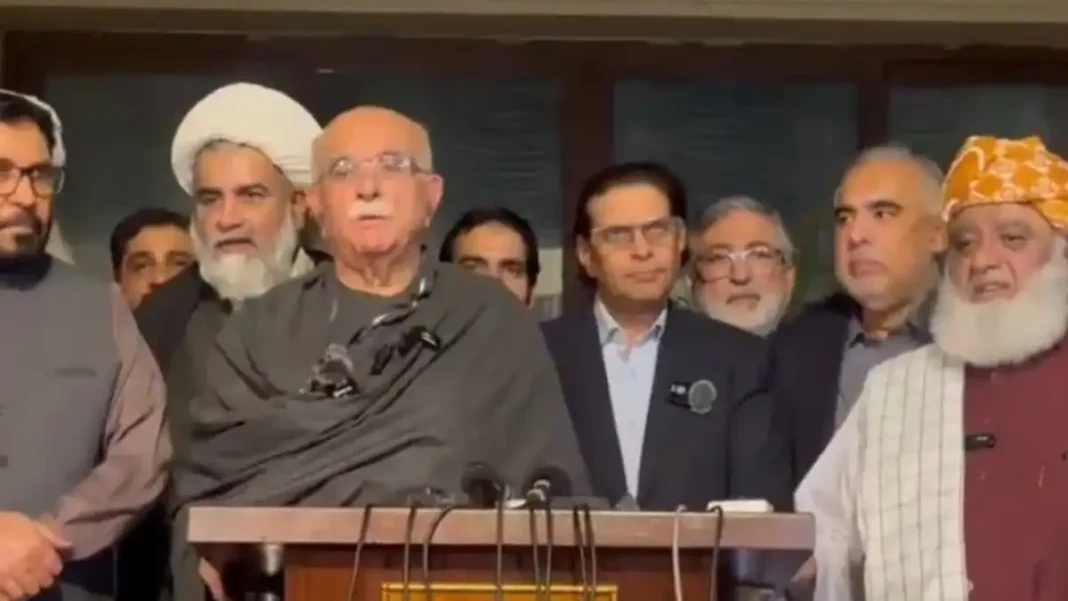
Opposition leaders gathered at the Islamabad residence of Jamiat Ulema-e-Islam (JUI-F) chief Maulana Fazlur Rehman, and then addressed a press conference. The JUI-F media cell confirmed that it was a meeting of the “united opposition”, and the Tehreek-e-Tahaffuz-e-Ain Pakistan (TTAP) confirmed the same.
Those present included National Assembly Opposition Leader Mahmood Khan Achakzai, Senate Opposition Leader and Majlis Wahdat-e-Muslimeen chief Allama Raja Nasir Abbas, former National Assembly speaker Asad Qaiser, PTI Secretary General Salman Akram Raja, and National Assembly Chief Whip Aamir Dogar.
Senator Noor-ul-Haq Qadri, Senator Kamran Murtaza, former Khyber-Pakhtunkhwa chief minister Akram Khan Durrani, JUI-F leaders Hafiz Hamdullah, Maulana Attaur Rehman and Maulana Attaul Haq Darvesh, and Senator Maulana Salahuddin Ayubi also attended, along with Pashtun Tahaffuz Movement spokesperson Hussain Ahmad Yousafzai and PTI core committee member Khalid Yousaf Chaudhry.
Fazl residence meeting: what the opposition discussed
The meeting discussed unity among opposition parties, the supremacy of the Constitution and the law, and the protection of democratic rights. Leaders also discussed a joint strategy for the current political situation and their future course of action.
That agenda matters because, until now, the opposition response to the Khyber-Pakhtunkhwa takeover has come in separate voices. Fazl has spoken in the National Assembly. PTI has challenged the move in court and in public. Achakzai has led TTAP’s constitutional campaign. This meeting puts those voices in one room, under one label, for the first time.
A delegation of PTI and TTAP leaders had already expressed full support for Fazl after his National Assembly speech, and condemned what they called character assassination of the JUI-F chief by government ministers. The residence meeting takes that public show of support a step further, into a shared plan.
Why Khyber-Pakhtunkhwa is at the centre
On October 11, governor’s rule and an emergency were imposed in Khyber-Pakhtunkhwa, moving executive authority from the PTI-led provincial government to the governor. An 11-member advisory council was formed to assist the governor in running provincial affairs.
The federal government also set up a separate administrative structure for 12 districts, with an area representative and a development council in each, to handle local representation and development planning.
The federal cabinet later approved the transfer of powers delegated to the Khyber-Pakhtunkhwa chief minister to the provincial governor for day-to-day affairs during the emergency, as Feature Pakistan reported in Cabinet ratifies Kuwait defence agreement, new notes. Prime Minister Shehbaz Sharif also announced a Rs160 billion development package for the province, with security given priority, in the same cabinet meeting covered in Pakistan middle east peace efforts continue, PM says.
Fazl has rejected the takeover outright. He accused the government of backing out of talks with PTI and the opposition, despite initially agreeing to their demands. He said that if an emergency had to be imposed, it should fall on the federal government, which he described as illegitimate, and he accused the government of misusing the Constitution.
That criticism spilled into the assembly, where federal ministers hit back, accusing Fazl of overlooking his own part in forming and toppling governments. Interior Minister Mohsin Naqvi criticised Fazl over his opposition to governor’s rule, and suggested that the religious-political leader was unhappy at not being offered a role in the new provincial setup.
Fazl had already warned of street agitation over the province’s resources row, as Feature Pakistan reported in Fazl street agitation hint over KP resources row. The residence meeting now gives that warning a wider base, since it carries the names of the opposition’s main parliamentary leaders, not only the JUI-F chief.
What happens next
The meeting produced a shared forum, not yet a shared programme. No joint declaration, protest date, or court filing was announced in The Express Tribune’s report of the gathering. The test will be whether the leaders who sat together at Fazl’s residence act together in parliament, in court, and on the street in the days ahead.
Two tracks are already running in parallel. PTI has challenged the Khyber-Pakhtunkhwa emergency in court, while the federal government is pressing ahead with the advisory council and the district structure. The opposition’s joint forum now sits across both tracks, and its next move will show whether unity at one meeting can hold under the pressure of the weeks to come.
Frequently asked questions
Who attended the meeting at Fazlur Rehman’s residence?
Mahmood Khan Achakzai, Raja Nasir Abbas, Asad Qaiser, Salman Akram Raja, Aamir Dogar, and senior JUI-F, PTI, TTAP, and PTM leaders attended the united opposition meeting.
Why did the opposition meet?
Leaders met to discuss unity among opposition parties, constitutional supremacy, democratic rights, a joint strategy for the political situation, and their future course of action.
When was governor’s rule imposed in Khyber-Pakhtunkhwa?
Governor’s rule and an emergency were imposed in the province on October 11, moving executive authority from the PTI-led provincial government to the governor.
What administrative structure now runs the province?
An 11-member advisory council assists the governor, and a separate structure for 12 districts, with an area representative and a development council each, handles local representation and development.
Has the opposition announced a joint protest or court case?
No joint declaration, protest date, or court filing was announced in the report of the meeting. PTI’s court challenge to the emergency is running separately.