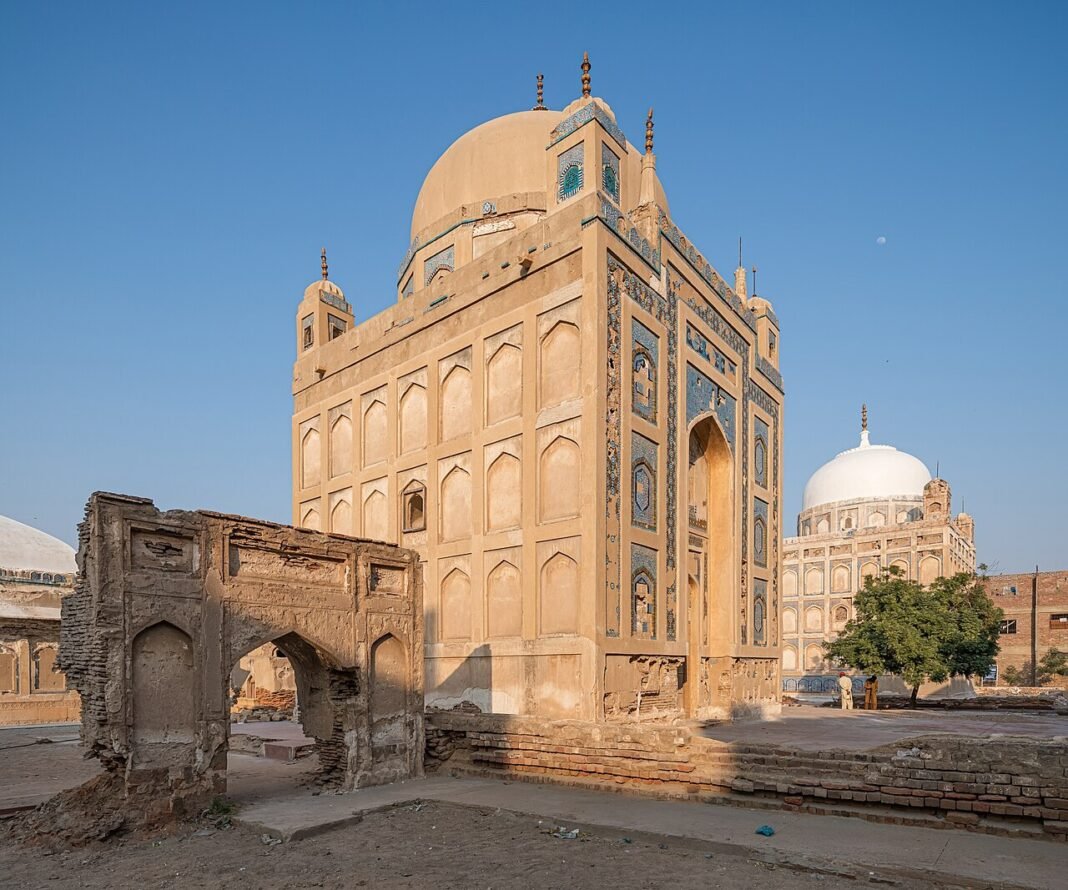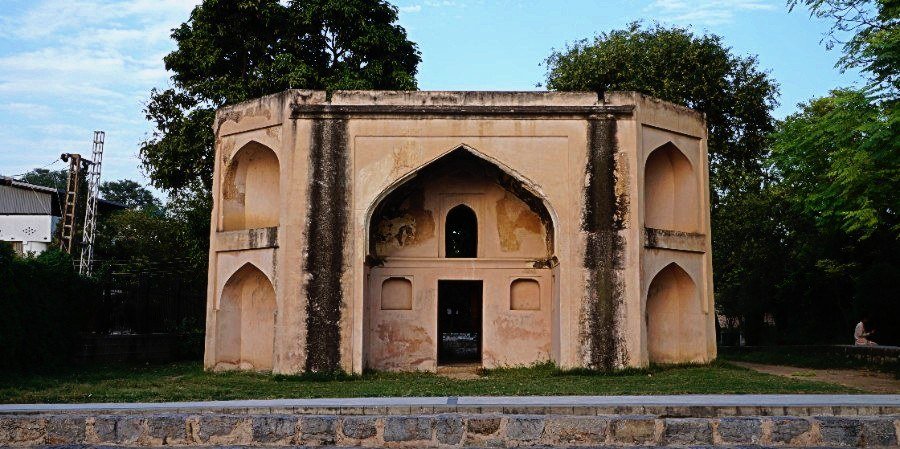
Across the road from one of Sikhism’s holiest shrines, down a quiet pathway into a walled garden, stands one of the great small mysteries of Mughal architecture: an elegant octagonal tomb, fronted by a still fish pond, built by an emperor’s minister as his own mausoleum — and then given, on the emperor’s orders, to two royal physicians instead. Also, this is Hakim’s Tomb at Hasan Abdal, the 16th-century Hakeemon ka Maqbara that most travelers speed past on the Grand Trunk Road without ever knowing it is there. It is an exact contemporary of Attock Fort, raised under the same supervision.
Its vaulted roof still carries its original rose-motif decoration. Pair it with the Gurdwara Panja Sahib across the road and the Buddhist ruins of Taxila down the highway. You have one of the richest half-day heritage circuits in northern Punjab. This Hakim’s Tomb travel guide explains the real history of the two hakims, what to look for in the architecture, and how to fold this hidden monument into your next trip between Islamabad and Peshawar.
Quick Facts
- Location: Hasan Abdal, Punjab, on the Grand Trunk Road, opposite the eastern gate of Gurdwara Panja Sahib
- Altitude: Low foothill country at the edge of the Potohar plateau
- Famous For: The 16th-century octagonal tomb of two Mughal royal physicians; the fish pond and garden complex; the adjoining Tomb of Lala Rukh
- Nearest City: Islamabad, about 40 to 48 km to the southeast
- Accessibility: Very easy; right on the Grand Trunk Road between Rawalpindi and Attock, about 45 minutes from Islamabad
- Known Landmarks: Gurdwara Panja Sahib (across the road), shrine of Baba Wali Kandhari, Tomb of Lala Rukh, Attock Fort
- Best For: Mughal architecture lovers, history buffs, Sikh heritage pilgrims combining Panja Sahib, day-trippers from Islamabad
Why Visit Hakim’s Tomb
Some monuments impress you with scale; Hakim’s Tomb impresses you with its story. A powerful minister of Emperor Akbar, Khawaja Shamsuddin Khawafi, built this tomb for himself between 1581 and 1583 — and then fate intervened. The emperor commanded that two of his royal physicians, the brothers Hakim Abdul Fateh Gilani and Hakim Humayun Gilani, be buried here instead. Also, the minister’s own tomb became someone else’s memorial. It is the kind of human twist that no textbook quite captures. It is written into the very stones of the building: a tomb designed for one man’s ambition, completed for two brothers’ service.
Then there is the setting, which is genuinely lovely. The tomb stands on a platform beside a tank — a still pond full of fish — and the water is part of the design, doubling the building in its reflection. The octagonal, two-storey form with its great Persian iwan arches on each cardinal side is pure high-Mughal architecture, decades before the Taj Mahal. Its vaulted roof inside still carries its decoration of rose motifs. Because so few tourists come here, you will likely have the garden, the pond. The tomb to yourself, with only the sound of the water and the parakeets.
At the Crossroads of Four Heritages
Finally, the location makes it irresistible. Also, Hakim’s Tomb sits directly across from Gurdwara Panja Sahib, one of the most sacred sites in Sikhism, and minutes from the shrine of Baba Wali Kandhari. Taxila’s Buddhist ruins are a short drive away. Attock Fort — built under the same supervision as this tomb — guards the Indus crossing down the road. Nowhere else in Pakistan can you stand in one afternoon at the intersection of Sikh, Sufi, Buddhist. Mughal heritage quite like this. If you are driving the Grand Trunk Road anyway, there is no excuse to miss it.
History of Hakim’s Tomb
The story begins with Khawaja Shamsuddin Khawafi, a minister of the Mughal emperor Akbar and his superintendent of construction — the man overseeing the building of Attock Fort between 1581 and 1583. Also, Khawafi served for a time as Governor of Lahore and spent about five years around Hasan Abdal and Attock. For example, like many powerful men of his age, he decided to build his own mausoleum in his lifetime, choosing a spot at Hasan Abdal beside a tank, and raising an octagonal tomb of undressed stone, plastered in lime and concrete, with a vaulted roof decorated with rose motifs.
But the tomb was never to be his. In 1597, on the orders of Emperor Akbar, two royal hakims — physicians of the Mughal court — were buried here instead. Also, they were brothers: Hakim Abdul Fateh Gilani Masiuddin, who died in 1589. Hakim Humayun Khwaja Gilani, who died in 1595. Akbar himself visited the site after returning from one of his trips to Kashmir, honouring the physicians’ memory in person. The minister’s tomb had become the Hakims’ tomb — Hakeemon ka Maqbara — and the name stuck for the next four centuries.
Graves Levelled, Walls Still Standing
The centuries were not always kind. During the Sikh period. Many Islamic-era buildings in the region were damaged or repurposed, the two graves inside the tomb were removed and levelled, and local tradition holds that the complex was used as an administrative office during the Khalsa era. The building itself survived, and its architecture has since been restored. No historical record confirms her identity.. Still, beside it, in the walled garden reached by a paved path from the pond, stands the smaller Tomb of Lala Rukh — traditionally said to be a Mughal princess, The Archaeology Department’s plaque attributes the grave to a lady of Emperor Humayun’s family.
Local lore variously calls her Humayun’s daughter or Jahangir’s daughter, said to have died of sickness while traveling to Kashmir. The mystery only adds to the garden’s quiet spell.
Top Things to Do in Hakim’s Tomb
Study the tomb’s Mughal architecture
Walk slowly around the octagonal, two-storey structure and read it like a document. Also, the large Persian-style iwan gateway arches on each of the four cardinal sides span the full height of both storeys — a bold, confident gesture of early Mughal design. Flanking them are four smaller niches, also in the Persian style. In fact, step inside and look up: the vaulted roof is decorated with rose motifs, a delicate surprise in a building of such plain stone. The tomb measures about 11 metres on each side and stands on a platform east of the tank. The whole composition — building, platform, water — was conceived as one piece.
Sit by the fish pond
The tank in front of the tomb, measuring about 38 by 21 metres, is full of fish and is as much a part of the monument as the masonry. Also, In Mughal garden design, water was never decoration alone. In fact, it cooled the air, doubled the building in reflection, and gave the place its stillness. Bring a few minutes of quiet here; it is the best seat in Hasan Abdal.
Visit the Tomb of Lala Rukh
A paved path leads from the pond to a small walled garden holding the Tomb of Lala Rukh — a rectangular stone pedestal grave with no inscription, kept in relatively good condition. Also, seven-sided domed towers stand at the garden’s four corners. Ask the caretaker about the legends: a Mughal princess, a daughter of Humayun or Jahangir, buried on the road to Kashmir. In fact, no one knows for certain, and the garden is all the more atmospheric for it.
Cross the road to Gurdwara Panja Sahib
Directly opposite the tomb’s eastern side stands one of the holiest sites of Sikhism. The gurdwara marks the spot where Guru Nanak is believed to have stopped a boulder with his hand — the “panja” (palm print) is still shown to pilgrims — and its spring-fed pool draws devotees year-round. Also, combining the Mughal tomb and the Sikh shrine in a single visit is the essential Hasan Abdal experience: two faiths, two centuries, one crossroads town.
Climb to the shrine of Baba Wali Kandhari
The hilltop shrine of the saint Baba Wali Kandhari — also associated with the Guru Nanak legends of Hasan Abdal — overlooks the town and offers the best panoramic view of the area. Also, the climb is short and the vista, over the GT Road, the gurdwara. The Margalla Hills in the distance, is superb at golden hour.
Famous Places In and Around Hakim’s Tomb
- Gurdwara Panja Sahib — one of Sikhism’s holiest shrines, directly across the road
- Tomb of Lala Rukh — the mysterious walled-garden tomb adjoining the Hakims’ complex
- Shrine of Baba Wali Kandhari — the hilltop Sufi shrine with panoramic views
- Taxila ruins — the great Gandharan Buddhist sites (Dharmarajika, Jaulian, Taxila Museum), a short drive southeast
- Attock Fort — Akbar’s great Indus fortress, built 1581–1583 under the same supervision as the tomb
- Attock Tomb — another Mughal-era tomb monument down the Grand Trunk Road
How to Reach Hakim’s Tomb
Hasan Abdal straddles the Grand Trunk Road between Rawalpindi and Attock, roughly 40 to 48 km northwest of Islamabad — an easy 45-minute to one-hour drive. Also, From Islamabad, take the GT Road (N-5) toward Taxila and continue to Hasan Abdal. In fact, the tomb complex lies just off the road opposite the eastern gate of Gurdwara Panja Sahib, down a pathway into the garden. From Lahore it is about 330 km (around four and a half hours) on the motorway and GT Road. From Peshawar, it is roughly 170 km east. The Karachi journey is around 1,400 km — fly to Islamabad and drive.
Public transport is straightforward: wagons, coasters, and buses ply the GT Road constantly between Rawalpindi/Islamabad and Attock/Peshawar. Also, it will drop you at Hasan Abdal’s main bazaar, from where the tomb is a short rickshaw ride. The nearest railway station is Hasan Abdal station on the main line. Allow twenty to forty minutes for the tomb and garden themselves, and half a day for the full Hasan Abdal circuit including Panja Sahib and the Wali Kandhari shrine. Add Taxila for a full day.
Route Details
From Islamabad: Take the Grand Trunk Road (N-5) northwest through Taxila; continue about 20 km past Taxila to Hasan Abdal. Also, watch for the Gurdwara Panja Sahib signboards. The tomb is opposite the gurdwara’s eastern gate. From Lahore: M-2 to Islamabad, then the GT Road as above (about 330 km total). From Peshawar: GT Road east via Nowshera and Attock (about 170 km). Park near the gurdwara; the tomb garden is a two-minute walk across the road.
Where to Stay in Hakim’s Tomb
Hasan Abdal is a small GT Road town, and most visitors stay in Islamabad — 45 minutes away — where the full range of hotels, from luxury properties to budget guesthouses, is available. Meanwhile, this makes Hakim’s Tomb an ideal day trip: leave Islamabad after breakfast, see the tomb, Panja Sahib. In fact, Taxila, and be back for dinner. For those who prefer to stay closer, Taxila town has mid-range hotels and rest houses catering to visitors of the archaeological sites. The GT Road strip around Hasan Abdal has simple highway hotels and guesthouses.
If you are combining the tomb with Attock Fort and the Indus crossing, consider overnighting in Taxila or Wah Cantt, both within half an hour. Also, camping is not established at the site and is unnecessary given how close Islamabad is. Book Islamabad hotels a few days ahead in spring and autumn, the peak seasons for northern Pakistan travel.
Where to Eat: Local Foods of Hakim’s Tomb
The GT Road around Hasan Abdal is dhaba country, and eating here is part of the journey. Also, the roadside dhabas serve the Punjabi-Potohari classics: dal makhani-style lentils, chicken karahi, mutton dishes, fresh tandoori rotis, and lassi in the tall steel glasses of the highway. In fact, a full dhaba meal costs a few hundred rupees per person — budget-friendly by any standard. The dhabas near Taxila and Hasan Abdal are accustomed to travelers and quick with service.
In Hasan Abdal town itself, the bazaar has sweet shops selling fresh mithai, samosa and pakora stalls for the afternoon. The standard desi breakfast of halwa puri and nihari on weekend mornings. If you are visiting Panja Sahib as well, note that the gurdwara serves langar (the free community kitchen) to all visitors regardless of faith — a moving experience and a memorable meal. Carry water for the walk around the tomb garden, though shops are only minutes away.
Weather in Hakim’s Tomb
Hasan Abdal sits at the edge of the Potohar plateau, and its weather closely follows Islamabad’s: cold, foggy winters. Also, a glorious spring; a hot summer tempered by the monsoon; and a golden autumn. In fact, the tomb garden is pleasantest from October to March. The air is clear and the walk between the monuments is comfortable. Summer afternoons can be harsh on the exposed platform, so visit early in the day. Winter fog on the GT Road can slow the drive from Islamabad — allow extra time on December and January mornings.
| Season | Temperature Range | Conditions |
|---|---|---|
| Winter (Dec–Feb) | 3–19°C | Cold, often foggy mornings; clear crisp afternoons |
| Spring (Mar–Apr) | 12–32°C | Pleasant and green; the loveliest season |
| Summer (May–Jun) | 24–38°C | Hot; visit early morning or late afternoon |
| Monsoon (Jul–Sep) | 25–35°C | Humid with heavy showers; the garden is lush |
| Autumn (Oct–Nov) | 14–32°C | Clear and golden; excellent for sightseeing |
Language and Culture of Hakim’s Tomb
The Hasan Abdal area speaks Punjabi in its Potohari dialect, with Urdu universally understood and English workable at hotels and the museum. Also, the town’s culture is shaped by its position on the Grand Trunk Road and its extraordinary religious layering: Sikh pilgrims at Panja Sahib, Sufi devotees at the Wali Kandhari shrine. Muslim residents who live comfortably with both. Visitors are expected to dress modestly and remove shoes before entering the gurdwara or any shrine. At Panja Sahib, covering your head is required (scarves are available at the entrance).
Photography is welcome at the tomb complex but be discreet around worshippers at the gurdwara and shrines — ask before photographing people at prayer. The caretakers at the tomb garden are usually happy to share the local legends. A small tip is appreciated but never demanded. If you accept langar at Panja Sahib, sit with the congregation, eat what is served, and observe the simple etiquette of the hall.
Shopping in Hakim’s Tomb
Hasan Abdal’s bazaar is a typical GT Road market: cloth merchants, crockery, sweets, and everyday goods at local prices. It is not a craft destination, so set your expectations accordingly. Also, the pleasure is in the stroll, the mithai shops, and the tea stalls. For genuine souvenir shopping, combine the trip with Taxila, where shops near the museum sell Gandharan-style replica sculptures, coins, and books on the region’s Buddhist heritage.
There are no shopping malls at Hasan Abdal, and you will not miss them. If you want something to take home from the tomb itself, the small bookstalls sometimes found near Panja Sahib and the Taxila Museum sell illustrated guides to the area’s monuments — a better memento than anything mass-produced.
Local Events and Festivals
The most significant annual gathering at Hasan Abdal is the Saka Panja Sahib commemoration, observed each year around 31 October at Gurdwara Panja Sahib. It marks the martyrdom of 1922, when Sikh volunteers stopped a train carrying prisoners to serve them langar. It draws Sikh pilgrims from across Pakistan and abroad. The gurdwara is at its most vibrant — and most crowded — during this commemoration and around Baisakhi in April, the great Sikh harvest festival.
The urs celebrations of the region’s Sufi saints, including Baba Wali Kandhari, follow the Islamic lunar calendar and bring qawwali and crowds to the shrines. If you visit during a major Sikh or Sufi gathering, expect the town to be busy and the GT Road slow — and expect also to witness Hasan Abdal at its most alive.
Travel Tips for Hakim’s Tomb
Packing Essentials
For an October-to-March visit, bring a warm layer — mornings on the Potohar plateau are cold — plus sun protection for the midday glare off the tomb’s plastered walls. Also, comfortable walking shoes handle the garden paths and the climb to the Wali Kandhari shrine. If you plan to enter Panja Sahib, carry a headscarf or use one provided at the entrance. A water bottle and a fully charged phone for photos complete the kit. This is a half-day trip, not an expedition.
Safety Tips
Hasan Abdal is a busy, well-traveled GT Road town with no special safety concerns for tourists. Take the usual care on the highway — the GT Road is fast and chaotic — and use marked crossings near the gurdwara. Keep valuables secure in crowded bazaar areas during festivals. The tomb garden is quiet and safe. The only hazard is the uneven old masonry, so watch your step on the platform.
Money & Connectivity
ATMs are available in Hasan Abdal town and plentiful in Islamabad and Taxila.. Still, bring some cash for rickshaws, dhabas, and small purchases, All mobile networks cover the GT Road corridor well. The tomb is minutes from the town’s markets if you need anything. There is no entry ticket system at the tomb garden at present, but carry small change in case of a caretaker’s fee.
Best Time to Visit Hakim’s Tomb
Autumn and Spring (October to April) — the ideal window
Clear skies, comfortable temperatures, and the garden at its best. October–November and March–April are the sweet spots: warm days, cool evenings, and perfect light for photography.
Winter (December to February) — good, with fog caveats
Crisp and pleasant once the morning fog lifts, but GT Road fog can delay the drive from Islamabad. Aim to travel after 10 in the morning.
Summer (May to September) — visit early
Hot, especially on the exposed tomb platform. Come at opening time, combine with the cool interiors of the Taxila Museum at midday, and save the garden for late afternoon.
Final Thoughts
Hakim’s Tomb is the kind of place that rewards the curious traveler and punishes the hurried one. Also, everyone drives past Hasan Abdal on the Grand Trunk Road. In fact, almost no one turns aside into the garden across from the gurdwara. Those who do find a 400-year-old architectural gem, a fish pond, a mysterious princess’s grave, and one of the best stories in Mughal history — a minister’s tomb that became two physicians’ memorial on an emperor’s whim.
Go between October and April. Give the tomb its unhurried half hour, cross the road to Panja Sahib, and then decide whether to continue to Taxila’s Buddhist ruins or Attock’s great fort. Also, few half-days in Pakistan pack in this much history.
FAQs
Where is Hakim’s Tomb?
In Hasan Abdal, Punjab, on the Grand Trunk Road about 40–48 km northwest of Islamabad, opposite the eastern gate of Gurdwara Panja Sahib.
Who is buried in Hakim’s Tomb?
Two royal Mughal physicians, the brothers Hakim Abdul Fateh Gilani (d. Also, 1589) and Hakim Humayun Gilani (d. In fact, 1595), buried here in 1597 on Emperor Akbar’s orders.
Who built Hakim’s Tomb?
Khawaja Shamsuddin Khawafi, Akbar’s minister and superintendent of construction, built it for himself between 1581 and 1583. Also, the emperor reassigned it to the hakims.
What is the best time to visit Hakim’s Tomb?
October to April, when the weather is clear and cool. Summer visits are best done early in the morning.
How do I reach Hakim’s Tomb from Islamabad?
Drive the Grand Trunk Road (N-5) northwest through Taxila to Hasan Abdal — about 45 minutes to an hour. Buses and wagons on the GT Road will also drop you at Hasan Abdal.
Is Hakim’s Tomb safe for tourists?
Yes. Also, it is a quiet garden monument in a busy GT Road town. In fact, Take normal highway precautions and watch your step on the old masonry.
Can I combine it with Panja Sahib and Taxila?
Easily — the tomb is across the road from Gurdwara Panja Sahib. Also, Taxila’s ruins and museum are a short drive southeast. All three make a perfect day trip from Islamabad.
What is the Tomb of Lala Rukh?
Her identity is unconfirmed.. Still, the smaller walled-garden tomb adjoining the Hakims’ complex, traditionally said to hold a Mughal princess — possibly a lady of Humayun’s family —
For more heritage journeys, browse our Explore Pakistan section, continue down the Grand Trunk Road with our Attock Tomb guide, explore Gandharan Taxila in our Bhir Mound guide, or pair it with Sikh heritage in our Ali Baig Gurdwara guide.