Stand at the edge of a green village, look down, and watch a river of ice grind its way through the Karakoram below your feet. That is Hopar. Few places on Earth let you meet a glacier without days of hard trekking, and this little valley in Nagar, Gilgit-Baltistan does it better than almost anywhere in Pakistan. Whether you are a serious trekker plotting a route to Rush Lake, a family looking for an unforgettable day trip from Hunza, or a photographer chasing the perfect frame of ice against apricot orchards, this Hopar Glacier, Nagar travel guide will help you plan it all.
Quick Facts
- Location: Hopar Valley, Nagar District, Gilgit-Baltistan, Pakistan (about 10 km from Nagar Khas)
- Altitude: Hoper village sits around 9,000 ft (about 2,740 m); the glacier viewpoints are higher still
- Famous For: Glacier viewpoints overlooking the Hoper, Bualtar and Barpu glaciers; the Rush Lake trek; Rush Peak (5,098 m)
- Nearest City: Gilgit (via the Karakoram Highway), then Karimabad in Hunza
- Accessibility: Jeep road from the KKH — roughly 17 km from the turn-off near Karimabad bridge, about 45–60 minutes; a 4×4 with high clearance is preferred
- Known Landmarks: Hoper Glacier viewpoint, Rush Lake (4,694 m), Miar Peak, Spantik (Golden Peak)
- Best For: Trekkers and hikers, adventure lovers, families on a day trip, photographers
Why Visit Hopar Glacier, Nagar
Most glaciers make you earn the view. You trek for days through moraine and thin air before the ice finally appears. Hopar breaks that rule in the best possible way. A short drive from the Karakoram Highway brings you to Hoper village, a bowl of green fields and fruit orchards tucked into the mountains of Nagar, and at the far end of the village the ground simply falls away to reveal a vast glacier spread out below. You can stand at the viewpoint in the morning and be back at your guesthouse for lunch.
For anyone who has always wanted to see a Himalayan glacier but cannot spare a week of trekking, this is the answer.
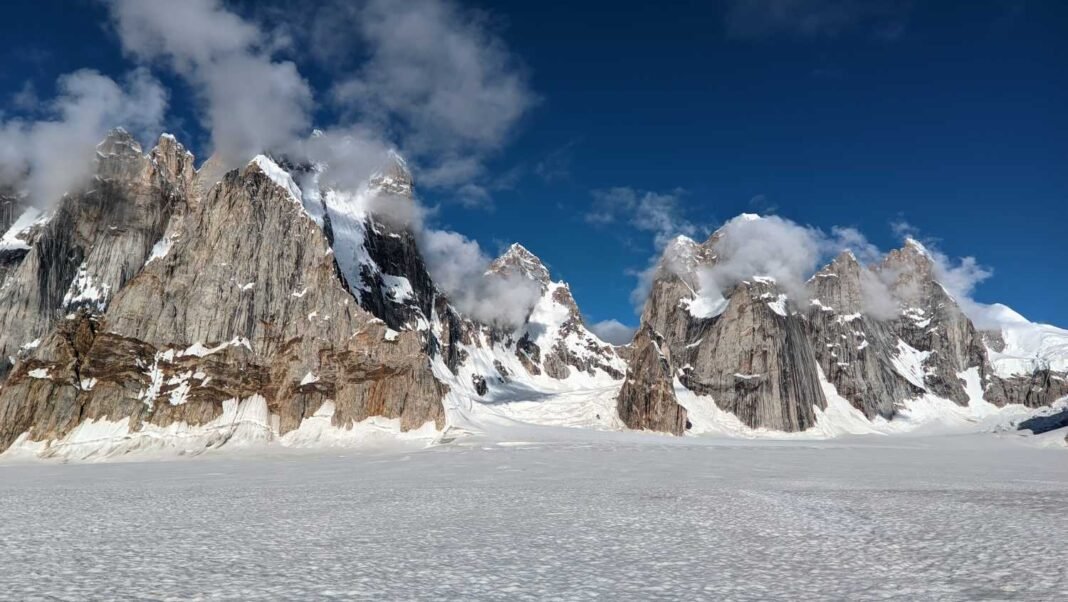
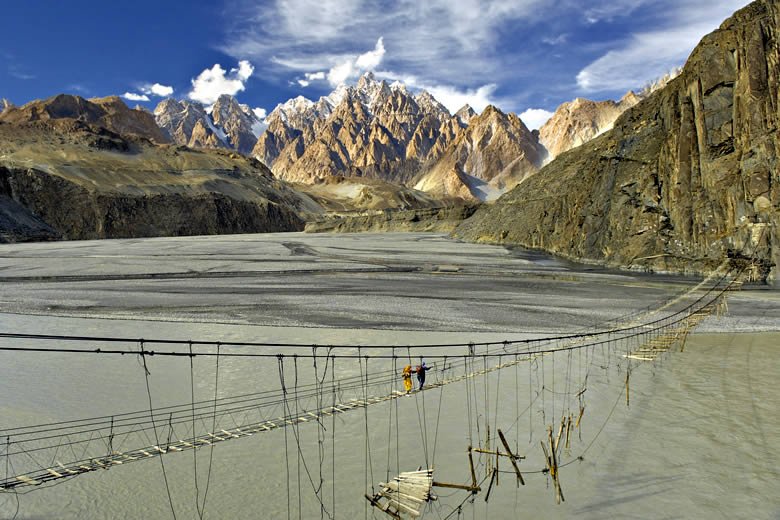
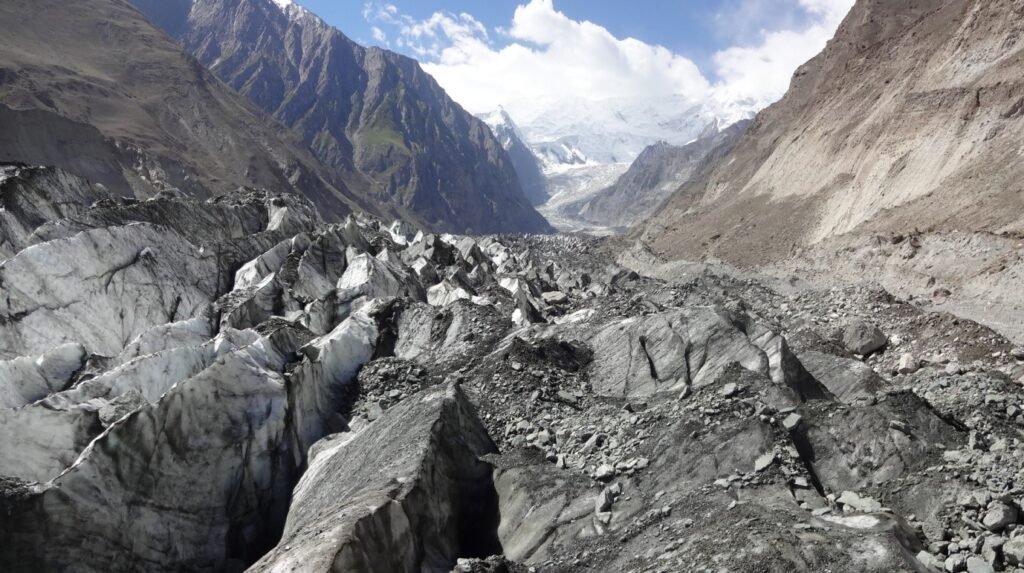
What makes the view here special is that you are not looking at one glacier but at a whole system of them. Also, the Hoper, Bualtar and Barpu glaciers flow together below the village, and across the valley the white sweep of the Bualtar glacier meets the dark, debris-covered mass of the Barpu. In fact, the contrast is astonishing — white ice, black moraine, brown barren peaks rising to 18,000 ft. The lush green of Hoper’s terraced fields in the foreground. It is one of the most photogenic panoramas in Gilgit-Baltistan. It changes character through the day as the light moves across the ice.
Gateway to Rush Lake and Hispar
For trekkers, Hopar is something else entirely: a gateway. Also, this valley is the starting point for the famous Rush Lake trek, which climbs to one of the highest alpine lakes in the world at 4,694 metres, and for the legendary Hispar Pass route that crosses Snow Lake to the Biafo Glacier in Baltistan — one of the great glacier traverses on the planet. In fact, serious expeditions and casual walkers share the same trailheads here, which gives the valley a wonderful energy in summer.
And then there is the quieter side of Hopar. The valley’s villages — Hoper itself and its neighbours — are home to Burushaski-speaking families who have farmed these terraces for generations. Apricots, cherries and the valley’s famous seed potatoes grow in orchards that have been irrigated by glacier melt for centuries. Stay a night in a family-run guesthouse, eat a home-cooked meal. You will understand why travellers who came for the glacier often say they fell in love with the village instead.
History of Hopar Glacier, Nagar
The story of Hopar is really the story of Nagar, the old princely state that ruled this valley for centuries. Also, Nagar was one of the two small mountain kingdoms — the other being Hunza, just across the river — that controlled the passes and trade routes of the central Karakoram. In fact, the Mirs of Nagar ruled from Nagar Khas, and their rivalry and alliance with the Mirs of Hunza shaped the region’s politics all the way into the modern era.
In 1891 the British launched the Hunza-Nagar campaign, bringing both states under British influence, and in 1974 the princely states were formally abolished and merged into what is now Gilgit-Baltistan.
Explorers of the Ice Basin
To the wider world, this corner of the Karakoram first became known through the great age of mountain exploration. Also, the Hispar-Muztagh range, which rises above Hoper, drew European surveyors and mountaineers in the late 19th and early 20th centuries. In fact, Martin Conway named the vast ice basin of Snow Lake in 1892. The Workman expeditions mapped the Hispar and Biafo glaciers in the early 1900s, putting this glacier country on the mountaineering map. For decades after that, Hoper remained known mainly to expedition porters and shepherds. The valley’s men have a long tradition of working on climbing expeditions, much like their neighbours in Baltistan.
Domestic tourism changed everything. As the Karakoram Highway opened the north to Pakistani travellers, word spread about the village where you could look down on a glacier. Today Hoper is firmly on the Hunza-Nagar tourist circuit, with small hotels, viewpoint kiosks and trekking guides serving a steady stream of visitors each summer. Yet it still feels far less crowded than the famous viewpoints across the river in Hunza. The valley’s inclusion within the Central Karakoram National Park has also brought growing attention to protecting its fragile glacier and pasture environment.
Top Things to Do in Hopar Glacier, Nagar
Stand at the Glacier Viewpoints
The main event, and it costs you nothing but the drive up. At the end of Hoper village, several viewpoints look straight down onto the glacier system below. The most striking sight is the meeting of the glaciers. The pale, cleaner ice of the Bualtar against the dark, rubble-streaked tongue of the Barpu. Visit in the morning for the clearest views before afternoon clouds build over the high peaks. A few small kiosks near the viewpoints sell tea and basic snacks, so you can linger.
Walk Down to the Glacier Ice
From the viewpoints, steep tracks descend to the glacier itself. Also, standing on the ice — hearing it groan and crack, seeing the blue meltwater channels and deep crevasses up close — is a completely different experience from viewing it above. In fact, go with a local guide, wear proper footwear, and never venture onto the ice alone or in bad weather. Crevasses on these glaciers are real and dangerous, and the surface is uneven moraine in places.
Trek to Rush Lake (4,694 m)
This is the valley’s signature trek and one of the finest short high-altitude treks in Pakistan. Rush Lake sits at 4,694 metres, making it one of the highest alpine lakes in the world and the second-highest lake in South Asia. For example, the classic trek takes about 5–7 days from Hoper, crossing the Barpu and Bualtar glaciers, with camps at places like Baricho Kor and Phai Phari. The reward is a still, jewel-like lake ringed by giants — Miar Peak, Spantik (Golden Peak), Malubiting — with K2 and Broad Peak visible on a clear day.
The best season is June to September, and you should go with an experienced local guide and proper acclimatisation.
Climb Rush Peak (5,098 m)
Above Rush Lake rises Rush Peak at 5,098 metres, a non-technical summit that fit trekkers can attempt as a day excursion from the lake camp. Also, the panorama from the top is the stuff of expedition brochures: the Karakoram’s great 7,000-metre peaks in every direction, the two great glaciers unfurled below, and on the clearest days the distant pyramid of K2. Start before dawn and be back by afternoon.
Trek the Miar and Barpu Glaciers
Shorter than the Rush Lake route, treks onto the Miar Glacier and across the Barpu offer a taste of real Karakoram glacier travel — ice formations, meltwater streams, and views up into the Hispar-Muztagh. Local guides in Hoper arrange day and overnight versions. These are also the approach routes for climbers heading to Miar Peak base camp.
Plan a Hispar Pass Expedition
For the truly ambitious, Hoper is the start of the Hispar Pass (5,128 m) traverse to the Biafo Glacier and Askole in Baltistan — a 2–3 week expedition across Snow Lake, one of the longest glacier journeys outside the polar regions. Also, this is serious mountaineering territory requiring full expedition support, and it should only be attempted with a reputable outfitter.
Wander the Village and Orchards
Slow down for an afternoon in Hoper itself. Also, walk the irrigation channels between terraced fields, visit the fruit orchards in cherry and apricot season (June–July), and watch village life unfold against a backdrop of 7,000-metre peaks. In fact, Hoper is famous in Gilgit-Baltistan for its seed potatoes, which are exported across the region — ask a local farmer about them and you will get an enthusiastic education.
Photography and Stargazing
The combination of green fields, dark glacier and white peaks makes Hopar a dream for photographers, especially at golden hour. At night, far from city lights, the Milky Way arches over the silent ice — bring a tripod and warm clothes.
Famous Places In and Around Hopar Glacier, Nagar
- Rush Lake (4,694 m) — one of the world’s highest alpine lakes, the valley’s crown jewel
- Rush Peak (5,098 m) — trekking summit with a 360-degree Karakoram panorama
- Barpu Glacier — the great dark glacier flowing below Hoper village
- Bualtar Glacier — the pale glacier meeting the Barpu in a spectacular confluence
- Miar Peak (6,824 m) — the dramatic pyramid guarding the valley’s head
- Spantik / Golden Peak (7,027 m) — the “golden” mountain glowing at sunset
- Nagar Khas — the old capital of the Nagar state, about 10 km away
- Karimabad and Baltit Fort — just across the river in Hunza, an easy combined visit
How to Reach Hopar Glacier, Nagar
Getting to Hopar is an adventure in itself, and the journey is half the reward. Most visitors combine it with a Hunza trip, since the turn-off is just across the river from Karimabad.
- From Islamabad: About 470 km to Gilgit via the Karakoram Highway — a long but spectacular 12 to 15-hour drive, usually broken with an overnight stop in Naran, Battagram or Chilas. In summer (May to October) the shorter route over the Babusar Pass via Naran is open and saves several hours.
- From Lahore: Add roughly 4–5 hours to the Islamabad timings; most travellers drive or take a bus to Islamabad first and continue north from there.
- From Karachi: Flying to Islamabad or Gilgit is the sensible option — the road journey is a two-day undertaking. From Gilgit, follow the same route as from Islamabad.
- Nearest airport: Gilgit Airport, with daily flights from Islamabad (about an hour, weather permitting). Skardu Airport is an alternative, but Gilgit is much closer to Nagar.
Road conditions by season: The Karakoram Highway is open year-round but can be blocked by landslides after heavy rain, especially in the monsoon months. Also, the Babusar Pass route closes in winter. The final 17 km jeep track from the KKH up to Hoper is rough in places — fine in a 4×4, slow going in a regular car.
Transport options: Private car or rented SUV for the whole trip. Also, 4×4 jeeps hired in Gilgit or Karimabad for the Hoper climb. In fact, public NATCO and private buses run Islamabad–Gilgit daily. Many visitors join a tour van or hire a driver for the full northern circuit.
Route Details
- Drive the Karakoram Highway north from Islamabad (or fly to Gilgit and start there).
- Continue past Gilgit toward Hunza, crossing the old Silk Route bridges over the Hunza River.
- Just after crossing the bridge outside Karimabad, take the signed turn south toward Nagar/Hoper.
- Follow the jeep road about 17 km uphill (45–60 minutes) through Nagar villages to Hoper.
- Drive to the end of the village and park at the glacier viewpoints — the ice spreads out below you.
If you are already exploring Hunza, you can read more in our Hunza Valley travel guide, and for the wider region see Explore Pakistan. Nearby peaks get their own guides too — see our Diran Peak travel guide and Distaghil Sar travel guide for the giants of the Hispar-Muztagh.
Where to Stay in Hopar Glacier, Nagar
Hopar is a village, not a resort town, so set your expectations for simple, warm hospitality rather than luxury. And you will not be disappointed.
Guesthouses in Hoper: A handful of small family-run hotels and guesthouses serve visitors, including the well-known Hoper Inn and a couple of other modest lodges that travellers mention by name. Rooms are basic but clean, meals are home-cooked. The hosts double as a mine of local knowledge — many can arrange guides and porters for the Rush Lake trek. Book ahead in July and August, when the valley fills up.
Camping: Trekkers heading for Rush Lake or the glaciers camp at designated campsites along the route (Baricho Kor, Phai Phari and others). Also, bring a proper four-season tent and a warm sleeping bag — nights are cold even in summer. Some local operators, such as the glamping-style camps that have appeared in recent years, offer set-up tents with meals if you book a trek package.
Karimabad and Gilgit: If you want more choice — proper hotels, hot water you can count on, restaurants — base yourself in Karimabad (our Aliabad Hunza guide covers the wider Hunza stay options) or Gilgit and visit Hoper as a day trip. The drive each way is very manageable.
Where to Eat: Local Foods of Hopar Glacier, Nagar
Nagar’s kitchens run on what the valley grows — wheat, potatoes, dairy, and astonishing fruit — and the food is hearty mountain fare.
Dishes to try: Shiro, a savoury wheat-flour dish. Also, ghalmey, a local bread preparation; and harissa, the slow-cooked wheat-and-meat porridge beloved across the northern valleys. In fact, dairy features heavily — fresh butter, buttermilk (diltar) and local cheese. In June and July the orchards explode with cherries, apricots and mulberries. Dried apricots and apricot oil are the classic take-home tastes of Nagar.
Where to eat: Your guesthouse will almost certainly offer the best meals — tell your host in advance and you will eat what the family eats. Also, near the glacier viewpoints, small kiosks sell tea, pakoras and basic snacks. For restaurants and bakeries, Karimabad across the river has the widest choice.
Costs: Eating in Hoper is budget-friendly by any standard. A home-cooked dinner at a guesthouse costs far less than a restaurant meal in the cities, and roadside tea and snacks are pocket change. Also, carry cash; there are no card machines in the village.
Weather in Hopar Glacier, Nagar
At around 9,000 ft, Hoper has a true mountain climate: short, glorious summers and long, snowy winters. The trekking viewpoints and Rush Lake route are snowbound from roughly November to April. Also, temperatures below are approximate daytime ranges.
| Season | Temperature Range | Conditions |
|---|---|---|
| Winter (Dec–Feb) | -10°C to 5°C | Heavy snow; the glacier turns white again; the jeep track can be difficult or closed |
| Spring (Mar–May) | 5°C to 15°C | Blossom season in the orchards; melting snow; viewpoints open up by late spring |
| Summer (Jun–Aug) | 12°C to 25°C | Peak season; clearest glacier views; Rush Lake trek at its best |
| Autumn (Sep–Nov) | 2°C to 18°C | Golden poplars and harvest colours; crisp air; fewer visitors |
Language and Culture of Hopar Glacier, Nagar
The people of Hoper speak Burushaski, the fascinating language isolate of the Hunza-Nagar region that is unrelated to any other known language. Also, urdu is widely understood, and younger people often speak some English. The valley is predominantly Ismaili Muslim, known for a strong emphasis on education and a welcoming attitude to visitors.
Cultural norms are relaxed by Pakistani standards, but respect still matters: dress modestly (cover shoulders and knees), ask before photographing people — especially women — and accept the inevitable offers of tea with good grace. If you are invited into a home, remove your shoes at the door. During the holy month of Ramadan, avoid eating or drinking conspicuously in public during daylight hours.
Shopping in Hopar Glacier, Nagar
Hopar itself has no bazaar to speak of — come for the views, not the shopping. But the wider Nagar region offers some special things to take home. Nagar is one of the most gemstone-rich valleys of Gilgit-Baltistan. Also, aquamarine, fluorite and other stones are mined in the Sumayar area. In fact, you will find gemstone jewellery in shops in Gilgit and Karimabad. Dried apricots, apricot oil, cherry products and local honey are the edible souvenirs, sold by village families and in Karimabad’s markets. Handwoven woollens and traditional caps are available in the Hunza bazaars across the river.
There are no shopping malls anywhere near Hoper — the nearest real shopping is in Gilgit.
Local Events and Festivals
Time your visit for late June and you may catch Ginani, the traditional first-harvest festival celebrated across Hunza and Nagar. Also, held on the summer solstice (21 June), Ginani gives thanks that the wheat crop has survived the mountain weather — historically the Mir of Hunza held court celebrations, and today the day brings music (the hareep tunes played for ten days beforehand), dancing, polo and communal meals of the new grain cooked into buttermilk. It is a wonderful window into Burusho culture if your dates align.
Travel Tips for Hopar Glacier, Nagar
Packing Essentials
Layers are everything: a warm fleece or down jacket even in summer, a windproof shell, sturdy hiking boots with ankle support, sun protection (the high-altitude sun is fierce), a reusable water bottle. Meanwhile, a basic first-aid kit. In fact, Trekkers need a four-season sleeping bag, trekking poles and a headlamp. A power bank is useful — electricity in the village can be intermittent.
Safety Tips
Never walk on the glacier without a local guide; hidden crevasses are a genuine danger. Check KKH conditions before setting out, as landslides can delay the drive. Acclimatise sensibly if you are trekking above 3,500 m — headaches and nausea mean descend, not push on. The region is considered safe for tourists. The local community is famously hospitable, but standard mountain sense applies: tell someone your plans and carry more water than you think you need.
Money & Connectivity
Bring all the cash you will need — there are no ATMs in Hoper. The nearest are in Karimabad and Gilgit. Mobile signals are patchy beyond the main towns. Coverage exists on the main networks along the KKH but fades in the side valleys. Buy any supplies, fuel and snacks in Gilgit or Karimabad before driving up.
Best Time to Visit Hopar Glacier, Nagar
Summer (June to September) — Peak Season
The classic window. Also, the jeep track is reliably open, the glacier viewpoints are at their most dramatic. The Rush Lake and Rush Peak treks are in season. July and August bring the most visitors, so book guesthouses ahead. Cherry and apricot season in June–July is a delicious bonus.
Spring (April to May) — Blossom and Quiet
Orchard blossom dusts the valley pink and white, crowds are thin, and daytime temperatures are pleasant. Higher treks may still hold snow, but the glacier viewpoints are usually accessible by late spring.
Autumn (October) — Golden and Clear
Poplars and apricot trees turn gold, the air is crystal clear, and you may have the viewpoints to yourself. Nights get cold — pack accordingly.
Winter (November to March) — For the Hardy
The glacier under snow is a pristine white wilderness and the village is profoundly peaceful, but access is difficult and most guesthouses close. Only for experienced winter travellers with local support.
Final Thoughts
Hopar is that rare thing: a genuinely world-class natural wonder that does not demand a week of suffering to reach. Also, in a single day you can stand above a living glacier, eat cherries in a 9,000-ft orchard, and sleep in a village that has watched these ice rivers flow for centuries. And if the mountains get under your skin — as they tend to do — the valley keeps bigger promises in reserve: Rush Lake, Rush Peak. The long white road to Snow Lake.
Come for the glacier, stay for the valley. Few day trips in Pakistan give you so much wonder per hour of travel, and even fewer leave you already planning your return before you have left. That is the quiet magic of Hopar — it turns sightseers into trekkers and trekkers into lifelong friends of Nagar.
FAQs
Where is Hopar Glacier located?
Hopar (also spelled Hoper) Glacier lies in Hopar Valley, Nagar District, Gilgit-Baltistan, about 10 km from Nagar Khas and a 17 km jeep drive from the Karakoram Highway near Karimabad, Hunza.
What is the best time to visit Hopar Glacier?
June to September is ideal. Also, the road is open, views are clearest, and the Rush Lake trek is in season. In fact, April–May offers blossom season with fewer crowds, and October brings golden autumn colours.
How do I reach Hopar Glacier from Islamabad?
Drive the Karakoram Highway to Gilgit (12–15 hours, or fly to Gilgit in about an hour), continue toward Hunza, take the signed turn to Nagar/Hoper just after the Karimabad bridge, and drive 17 km uphill (45–60 minutes) to the village and its glacier viewpoints.
Is Hopar Glacier safe for families?
Yes — the viewpoints at the end of Hoper village are easily reached and suitable for all ages. Also, only the descent onto the glacier ice and the high treks need a guide and proper fitness.
Can you walk on Hopar Glacier?
Yes, but only with a local guide. The glacier surface has hidden crevasses and uneven moraine; never walk on it alone or without proper footwear.
How long is the Rush Lake trek from Hoper?
The classic Rush Lake trek takes about 5–7 days round trip from Hoper village, reaching the lake at 4,694 m. Also, June to September is the trekking season, and a local guide is strongly recommended.
Where can I stay near Hopar Glacier?
Hoper village has small family-run guesthouses such as Hoper Inn, plus camping options for trekkers. For more choice, stay in Karimabad or Gilgit and visit on a day trip.
What food is Hoper famous for?
Nagar’s mountain cuisine — dishes like shiro, ghalmey and harissa — plus summer cherries, apricots and mulberries from the valley orchards. Also, the region’s famous seed potatoes.