There is a bridge in the high north of Pakistan that has terrified and thrilled travelers in equal measure. Also, a swaying ribbon of wooden planks and steel cable stretched across the roaring Hunza River, high above the water, with gaps between the steps wide enough to make your stomach drop. This is the Hussaini Suspension Bridge, and if you are looking for the one experience in Gilgit-Baltistan that you will be telling people about for years, this is it. This hussaini suspension bridge travel guide is your complete companion to planning the visit: why it deserves a place on your itinerary.
To go, what to do around it, and how to reach it from anywhere in Pakistan.
Quick Facts
- Location: Hussaini village, Gojal (Upper Hunza), Hunza District, Gilgit-Baltistan, Pakistan — connecting Hussaini and Zarabad villages across the Hunza River.
- Altitude: Around 2,400 meters above sea level (the nearby town of Gulmit sits at 2,408 meters).
- Famous For: One of the most famous suspension bridges in the world — 194 meters (about 635 feet) of wooden planks, wide gaps, and a swaying span over glacial meltwater. Listed by Condé Nast Traveler in 2013 among the world’s dangerous crossing bridges.
- Nearest City: Aliabad (about 45 km away); Gilgit, the regional capital, about 132 km to the southwest.
- Accessibility: Road — the Karakoram Highway passes nearby; from the highway parking area it is a 10 to 20 minute downhill walk to the bridge. Air — fly to Gilgit, then drive 3.5 to 4 hours.
- Known Landmarks: The bridge itself, Borith Lake, the Passu Cones, Attabad Lake, Gulmit village.
- Best For: Adventure seekers, photographers, thrill-testers, travel vloggers, and confident older children and adults who are not afraid of heights.
Why Visit Hussaini Suspension Bridge
Some places are beautiful, and some places change how you feel about yourself. Meanwhile, the Hussaini Suspension Bridge belongs to the second kind. It was never built as a tourist attraction. It was built because the people of Hussaini village needed a way to reach their fields and homes in Zarabad on the far bank of the Hunza River — and every plank, cable, and gap in it carries that honest, working history. When you step onto it, you are not walking a theme-park ride. You are walking a piece of real mountain life.
That honesty is exactly what makes it irresistible. Also, the bridge hangs high above one of the fastest rivers in the Karakorams, and it moves. In fact, the wind catches it, the planks shift under your feet. In addition, the Hunza River thunders below in a shade of blue-grey that photographs can never quite capture. The famous wide gaps between the planks — deliberately built into the design to resist wind vibration — force you to watch every step. It is the kind of controlled fear that travelers chase across the world, and here you get it in its most authentic form.
Passu Cones, Borith Lake, and Your Story
Then there is the setting. For example, Gojal, the upper valley of Hunza, is one of the most dramatic landscapes in Pakistan: the needle-sharp Passu Cones rise like a crown on one side, the blue waters of Borith Lake sit quietly above the village. In fact, the Karakoram Highway threads its way along ancient Silk Road routes. The bridge is not a standalone stop. It is the centerpiece of a whole day of wonders — cross the bridge in the morning, picnic by Borith Lake at noon, photograph the Passu Cones at sunset. For the wider valley, browse our Gojal (Upper Hunza) travel guide and more Explore Pakistan features.
Few destinations in Pakistan pack this much into a single day.
Finally, come for the story you will take home. Meanwhile, everyone who has crossed it remembers the exact moment — the first plank, the first glance down, the laughter or silence of their companions, the relief and triumph of reaching the far bank. A trip to the Hussaini Suspension Bridge is not just sightseeing; it is a personal milestone. Plan it well, respect the bridge’s risks. It will reward you with one of the great adventure memories of your life.
History of Hussaini Suspension Bridge
The story of the Hussaini Suspension Bridge begins in the late 1960s. The communities of Gojal in Upper Hunza lived far more isolated lives than they do today. A bridge at this site was originally built around 1968. Local accounts record that the bridge was first built during the British rule in the village of Shishkat in Gojal, and during the construction of the Karakoram Highway it was shifted to Hussaini village in 1968 on the orders of the Mir of Hunza — Mir Muhammad Jamal Khan — so that it could connect the town of Zarabad on the far side of the river.
Before the bridge, villagers had to travel to another village 20 kilometers away and climb a dangerous hill track to reach Zarabad and their farmland there.
Over the decades the bridge was destroyed and rebuilt several times. Also, floods in the 1980s and 1990s damaged it. Meanwhile, the catastrophic Attabad landslide of January 2010 — which dammed the Hunza River and created the famous Attabad Lake — devastated the structure, after which it was reconstructed. For them this was never a monument.. As a result, each time, it was the people of Hussaini themselves who rebuilt it with rope, wood, and steel cable, using knowledge passed down through generations, It was their road to work.
Six Ropes, Wide Gaps, One Legendary Crossing
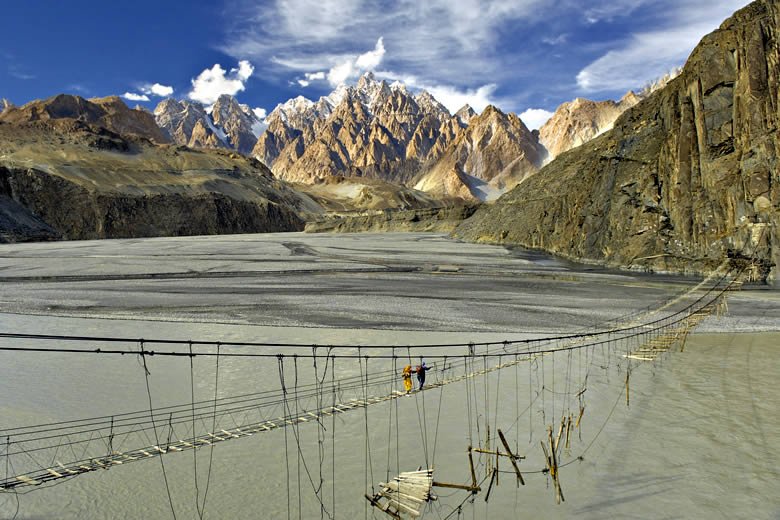
What the bridge looks like today is the result of that history: a 194-meter (635-foot) span of rectangular wooden planks held by six main ropes, with deliberately wide spaces between consecutive planks. Also, those gaps are not a flaw; they are an engineering choice to resist the wobbly vibrations driven by mountain winds. As road access and the Karakoram Highway brought the world to Gojal, what was once purely a working crossing became one of the most photographed bridges on the planet.
In 2013 the American travel magazine Condé Nast Traveler listed it among the dangerous crossing bridges of the world, and international media and documentary crews have featured it ever since.
The bridge has also seen tragedy that travelers should know about. In July 2022, a young student from Sindh fell from the bridge and drowned in the Hunza River. Authorities sealed the bridge for several days while investigations were carried out. The incident is a sobering reminder that this is a genuinely risky structure, not a playground — a lesson the local community, which charges a small maintenance fee for crossing, takes seriously.
Top Things to Do in Hussaini Suspension Bridge
Cross the Bridge Itself
This is the headline act. It delivers. From the parking area off the Karakoram Highway, a 10 to 20 minute downhill walk brings you to the start of the span. Pay the small community-maintained entry fee (older reviews mention around rs. 50, but treat that as outdated — carry small cash and pay what is posted), take a breath, and step on. The trick veterans recommend: hold the side ropes, take one step at a time. It do not look straight down through the gaps unless you want your knees to go weak.
If you are scared of heights, you can still enjoy the bridge from the viewpoint at either end. The view of it against the mountains is almost as thrilling as the crossing. Wear trekking shoes with good grip, keep your phone secured (taking photos one-handed mid-span is how phones end up in the river), and never cross when winds are strong or the bridge is closed.
Photograph the Bridge with the Passu Cones
The classic shot — the swaying bridge framed against the razor-sharp pyramid peaks of the Passu Cones — is one of the most famous images in Pakistan travel photography. Also, the best light is early morning or late afternoon. Tripods are allowed on the banks; on the bridge itself, secure everything. Photographers also love the autumn season, when the valley turns gold and the river runs low and bright.
Walk to Borith Lake
Just about 2 kilometers from Hussaini village lies Borith Lake, a serene alpine lake sitting quietly above the valley. Also, it is an easy walk or short drive from the bridge area. It makes the perfect calm contrast after the adrenaline of the crossing. The lake reflects the surrounding peaks on still mornings, and it is a favorite picnic and bird-watching spot. Many travelers combine the bridge and the lake in a single unhurried morning.
Take the Zipline and Visit the “Memory Wall” Shop
There is a zipline running alongside the bridge for those who want an extra shot of adrenaline after crossing (or instead of it). Also, and do not miss the small local shop near the bridge where a woman started a charming tradition: travelers write their trip memories on notes — some say over 2,000 handwritten notes on currencies, paper, and jewelry fragments have been left here. Leave yours.
Explore Gulmit, the Old Summer Capital
Just 8 to 10 kilometers back along the highway is Gulmit, the historic summer capital of the former Hunza state before its abolition in 1974, and today the tehsil headquarters of Gojal. Also, its centuries-old houses, the old summer palace of the Mir near the polo ground. Its small museum make it a worthwhile stop. Gulmit sits at 2,408 meters and is home to around 4,000 Wakhi people — a good place to feel the culture of the valley.
Famous Places In and Around Hussaini Suspension Bridge
- Borith Lake — peaceful alpine lake about 2 km from Hussaini village; great for reflections and picnics. Read our Borith Lake travel guide to plan that stop.
- Passu Cones — the iconic jagged peaks rising dramatically behind the bridge.
- Passu Glacier — a glacier south of the Passu Cones, accessible from Passu village.
- Gulmit — 8–10 km away; historic town, old summer palace, polo ground, museum.
- Attabad Lake — the stunning turquoise lake formed by the 2010 landslide, on the route from Aliabad. See our Attabad Lake travel guide.
- Shimshal Valley — about 55 km from Passu; a remote mountaineering valley for serious trekkers.
- Khunjerab Pass — the Pakistan-China border at 4,693 meters, a full-day drive further up the Karakoram Highway.
How to Reach Hussaini Suspension Bridge
Getting to the bridge is an adventure in itself, and part of the joy is the legendary Karakoram Highway (KKH), one of the highest paved international roads on earth. The bridge is signposted off the KKH: look for the parking area and big signs just after passing Gulmit village when traveling toward Passu. From Islamabad it is roughly 630 km (about 395 miles) of some of the most scenic — and occasionally nerve-testing — road in Pakistan.
- From Islamabad: Drive the Karakoram Highway via Mansehra, Besham or the shorter Babusar route (in summer) to Gilgit, then continue through Aliabad and Attabad Lake to Hussaini. Total driving time is 14 to 18 hours depending on route and stops — almost everyone breaks the journey overnight in Chilas or Gilgit. Alternatively, fly from Islamabad to Gilgit (about 1 hour, weather permitting) and drive the last stretch.
- From Lahore: Drive or fly to Islamabad first (about 4–5 hours by road), then follow the Islamabad route. Lahore to Gilgit flights are not available, so Islamabad is the gateway.
- From Karachi: Fly to Islamabad (about 2 hours) or Gilgit via Islamabad. Budget-conscious travelers sometimes fly to Islamabad and join an organized Hunza tour.
- Nearest airport: Gilgit Airport, about 130–140 km (3.5–4 hours’ drive) from the bridge. Flights are weather-dependent and frequently cancelled, so keep a buffer day.
Road conditions vary by season. In winter and early spring, landslides and snow can close sections of the KKH. Babusar Top (on the shorter Naran–Chilas route) is only open roughly June to October. During the monsoon (July–August), rain can trigger rockfalls — check road conditions before departure. Within Gojal, roads are paved but narrow. A normal car reaches the bridge parking fine in dry weather, though a high-clearance vehicle or jeep is more comfortable.
Route Details
The classic road itinerary: Islamabad → Mansehra → (Babusar Top in summer. Also, Besham in winter) → Chilas → Gilgit → Aliabad (central Hunza) → Attabad Lake → Gulmit → Hussaini village. In fact, the Gilgit to Hussaini leg is about 130–140 km and takes 3.5 to 4 hours, with Attabad Lake and Gulmit as natural breaks. In addition, From the bridge’s KKH parking area, follow the signed track downhill on foot for 10 to 20 minutes to reach the bridge. Tour vans and local jeeps can be hired in Gilgit, Aliabad, and Gulmit.
Public vans and NATCO buses run the Gilgit–Gojal corridor daily, and from Hussaini village a short walk or local lift gets you to the track.
Where to Stay in Hussaini Suspension Bridge
There are no hotels at the bridge itself — it is a village site — but the surrounding Gojal valley has a good range of places to stay. The best strategy is to base yourself in nearby Gulmit or Passu and visit the bridge as a day trip.
Mid-range hotels and guesthouses: Gulmit and Passu both have comfortable mid-range hotels and family-run guesthouses, many with valley views, hot water, and home-cooked meals. These cluster along the Karakoram Highway and in the villages. Book ahead in the peak season (June–October) because the best ones fill up. Budget options: simple guesthouses and hostels in Gulmit, Passu.
Aliabad cater to backpackers and student groups, and many tour packages include stays here. Camping: designated camping spots exist around Borith Lake and Passu for those who carry their own gear — nights are cold even in summer, so bring a proper sleeping bag. Luxury: for a premium stay, the well-known higher-end hotels of Karimabad (central Hunza) are about 1.5–2 hours away and can anchor a multi-day Hunza itinerary that includes the bridge. We name no specific hotel here because availability and quality change seasonally — check recent reviews before booking.
Where to Eat: Local Foods of Hussaini Suspension Bridge
Eating in Gojal is a highlight of the trip. Also, the Wakhi and Hunza cuisine of the valley is built around buckwheat, apricots, dairy, and mountain herbs — food shaped by a harsh climate and a famously long-lived people.
Dishes to try: chapshuro, the beloved meat-filled flatbread often called the pizza of Hunza. Also, ghalmandi and diram pitti, hearty layered breads. In fact, buckwheat pancakes served with apricot oil. In addition, butter tea and tumoro tea (a local herbal tea). And anything made with the valley’s dried apricots, mulberries, and apricot kernels. Yak meat dishes appear on some menus in Upper Hunza, and fresh trout is common in the region. Guesthouses in Gulmit and Passu serve the most authentic home-style versions — ask for the local menu, not the generic one.
Roadside dhabas along the KKH serve standard Pakistani fare (dal, chicken karahi, roti, rice) at budget-friendly prices. A full local meal in the valley is generally inexpensive compared to big-city rates. Carry snacks and water for the bridge walk itself, as there is little beyond the small shop near the parking area.
Weather in Hussaini Suspension Bridge
Gojal sits at around 2,400 meters in a cold desert climate. Also, the air is thin, the sun is strong, and temperatures swing hard between day and night. In fact, the valley gets minimal rainfall; most precipitation falls as snow in winter. Approximate seasonal ranges for the Hussaini–Gulmit area:
| Season | Temperature Range | Conditions |
|---|---|---|
| Winter (Dec–Feb) | -14°C to -26°C | Frigid and snowy; roads can be blocked; most tourism closed. Not recommended for travel. |
| Spring (Mar–May) | -5°C to 12°C | Blossom season in April — apricot and cherry blossoms blanket the valley; cool days, cold nights; roads reopening. |
| Summer (Jun–Aug) | 5°C to 25°C | Mild, pleasant days; cold nights; peak travel season; occasional monsoon-linked landslides on the KKH. |
| Autumn (Sep–Nov) | -2°C to 15°C | Golden foliage, clear skies, crisp air; October is superb for photography; gets cold fast after mid-November. |
Language and Culture of Hussaini Suspension Bridge
The people of Hussaini and surrounding Gojal are predominantly Wakhi — an ethnic group speaking the Wakhi language, an Eastern Iranian language, with cultural roots stretching across the Pamirs into Tajikistan, Afghanistan, and China. Many also speak Brushaski (the language of central Hunza), and Urdu is widely understood. Also, English is spoken in hotels and by guides. The valley is known for its warm hospitality, high literacy, and a culture of self-reliance. The bridge itself, rebuilt by villagers’ own hands, is the symbol of that spirit.
Visitors should dress modestly (cover shoulders and knees. Women may feel more comfortable with a headscarf in villages, though it is not strictly required), ask before photographing people — especially women — and greet elders respectfully. The local community is Ismaili Muslim and generally welcoming. The bridge is still a working crossing for villagers carrying goods and children. Give locals right of way, do not block the span for long photo sessions, and keep noise down. Alcohol and public smoking are frowned upon in villages.
Shopping in Hussaini Suspension Bridge
Do not expect shopping malls here — there are none, and the valley’s charm is in its small shops. Also, what you can buy: dried apricots and apricot oil (the valley’s most famous products), mulberries, walnuts, and almonds from village shops in Hussaini, Gulmit, and Passu. In fact, Handwoven Wakhi caps, shawls, and woolen socks. Handmade jewelry and embroidered items sold by women’s cooperatives; and local honey. Prices are reasonable and bargaining is gentle rather than aggressive. Buy directly from village shops where possible — the money goes straight to the families who rebuilt the bridge you came to see.
Travel Tips for Hussaini Suspension Bridge
Packing Essentials
Even in summer, pack layers: a warm fleece or jacket for mornings and evenings, a windbreaker for the bridge (it is always windier on the span), and sun protection — the high-altitude sun burns fast, so bring sunscreen, sunglasses, and lip balm. Trekking shoes with good grip are essential for the plank gaps. Carry a small daypack with water, snacks, and a basic first-aid kit. In spring and autumn add gloves and a warm hat. A power bank is useful since electricity can be intermittent in the valley.
Safety Tips
This bridge is genuinely dangerous and must be treated with respect. Cross one person at a time on narrow sections, hold the side ropes, step carefully through the plank gaps, and secure all belongings — phones, cameras, sunglasses. Do not cross in high wind, rain, or when the bridge is closed or under maintenance. Children should be closely supervised and very small children are better kept at the viewpoint. Wear the life jacket if one is provided at the site. Note the 2022 tragedy: the river below is glacial meltwater where survival after a fall is measured in minutes.
Cross in daylight, ideally morning when winds are calmer, and never under the influence of anything. Altitude is moderate (2,400 m) but take it easy on your first day if arriving from the plains.
Money & Connectivity
Carry cash — there are ATMs in Gilgit and Aliabad but very limited options in Gojal, and none at the bridge. Mobile signals are patchy: SCOM (the local network) works best in Gilgit-Baltistan, while other networks are unreliable or absent. Download offline maps before leaving Gilgit, inform your hotel of your plans. It do not rely on mobile data at the site.
Best Time to Visit Hussaini Suspension Bridge
Spring (April–May) — Blossom Season
The valley explodes in white and pink blossom, the river runs bright blue, and crowds are thin. Also, days are cool and pleasant for the crossing. In fact, this is arguably the most beautiful time to see Gojal.
Summer (June–August) — Peak Season
Warm days, fully open roads, all hotels operating, and the liveliest atmosphere. Also, the bridge is busiest — go early morning to cross with fewer people. In fact, watch for monsoon-related landslide warnings on the KKH.
Autumn (September–October) — Golden Season
Many travelers’ favorite: poplar and apricot trees turn gold, skies are crystal clear, and the light is perfect for photography. October brings cold nights, so pack warm.
Winter (November–March) — Off Season
Not recommended for most travelers. Extreme cold, snow, possible road closures, and limited services. Also, only experienced winter travelers with proper gear and local contacts should attempt it.
Final Thoughts
The Hussaini Suspension Bridge is not the easiest destination in Pakistan to reach. It is certainly not the safest-feeling one. And that is precisely the point. Also, in a world of polished attractions, this swaying span of wood and cable is refreshingly real: built by villagers for villagers, tested by floods and rebuilt by hand, and now shared with travelers brave enough to cross it. Pair it with Borith Lake, the Passu Cones. A night or two in Gulmit. You have a northern Pakistan itinerary that stands with anything in the Himalayas or Karakorams.
Go in spring for blossoms, summer for energy, or autumn for gold. Also, cross carefully, photograph respectfully, buy your apricots from the village shops, and leave your memory on the shop wall. In fact, the bridge will give you a story — make sure you are around to tell it.
FAQs
Where is the Hussaini Suspension Bridge located?
It is in Hussaini village, Gojal (Upper Hunza), Hunza District, Gilgit-Baltistan, Pakistan — about 45 km from Aliabad and 132 km northeast of Gilgit, connecting the villages of Hussaini and Zarabad across the Hunza River.
How long is the Hussaini Suspension Bridge?
The bridge is about 194 meters (635 feet) long, made of wooden planks held by steel cables and six main ropes, with wide gaps between the planks.
Is the Hussaini Suspension Bridge safe to cross?
It is a genuinely risky structure. Also, Condé Nast Traveler listed it among the world’s dangerous crossing bridges, and a fatal fall occurred in 2022. In fact, cross carefully, hold the ropes, wear provided safety gear, avoid high winds, and keep children closely supervised or at the viewpoint.
What is the best time to visit the Hussaini Suspension Bridge?
May to October is the main season. Also, april–May brings blossoms, June–August brings warm weather and full services, and September–October brings golden autumn colors and superb photography light.
How do I reach the Hussaini Suspension Bridge from Islamabad?
Drive the Karakoram Highway to Gilgit (14–18 hours, usually with an overnight stop) or fly to Gilgit, then drive 3.5–4 hours via Aliabad, Attabad Lake, and Gulmit. From the signed parking area on the KKH, it is a 10–20 minute downhill walk to the bridge.
Is the bridge suitable for families with children?
Confident older children can cross with close adult supervision. Also, it is not recommended for small children or anyone afraid of heights. The viewpoints at either end still offer a great experience without crossing.
Where can I stay near the Hussaini Suspension Bridge?
Base yourself in Gulmit (8–10 km away) or Passu, which have mid-range hotels, family guesthouses, and budget options. Also, luxury travelers can stay in Karimabad, about 1.5–2 hours away.
What food should I try near the bridge?
Try Hunza specialties like chapshuro (meat-filled flatbread), buckwheat pancakes with apricot oil, butter tea. Also, it dried apricots — best at guesthouses in Gulmit and Passu.