Two million years of history under one roof, in the middle of the capital — that is the promise of the Islamabad Museum. Most visitors to Islamabad head for the Margalla Hills or Faisal Mosque and never realize that a short drive away sits one of Pakistan’s most important archaeological museums, where stone tools older than humanity’s great migrations share gallery space with Gandharan Buddhas and Mughal miniatures. This Islamabad Museum travel guide will show you why it deserves a morning of your trip, and how to plan your visit.
Quick Facts
- Location: Islamabad, the federal capital — housed in the building of the Federal Department of Archaeology and Museums
- Established: September 2002
- Managed By: Federal Department of Archaeology and Museums (DOAM), Ministry of Information, Broadcasting and National Heritage
- Famous For: Chronological galleries from the Stone Age to the Mughal era; Gandharan Buddhist sculpture; 2-million-year-old Soan Valley tools
- Nearest City: Right in Islamabad — minutes from Blue Area and the city’s cultural belt
- Accessibility: Easy; reachable by car, ride-hailing, or local transport from anywhere in the twin cities
- Known Landmarks Nearby: Lok Virsa Heritage Museum, National Art Gallery, Faisal Mosque, Margalla Hills
- Best For: History lovers, students, families, and anyone who wants to understand Pakistan’s deep past in a single visit
Why Visit Islamabad Museum
Pakistan’s history did not begin in 1947. The Islamabad Museum is the place that makes you feel that truth in your bones. Walk through its galleries in order and you walk through time itself: you start with stone tools knapped two million years ago in the Soan Valley — among the earliest evidence of human activity anywhere in South Asia — and you end, a few rooms later, amid the refined miniature paintings and astrolabes of the Mughal court. Few museums in the country offer such a complete, chronological journey in a single building. That is exactly why the Islamabad Museum matters.
Gandhara’s Finest Sculpture
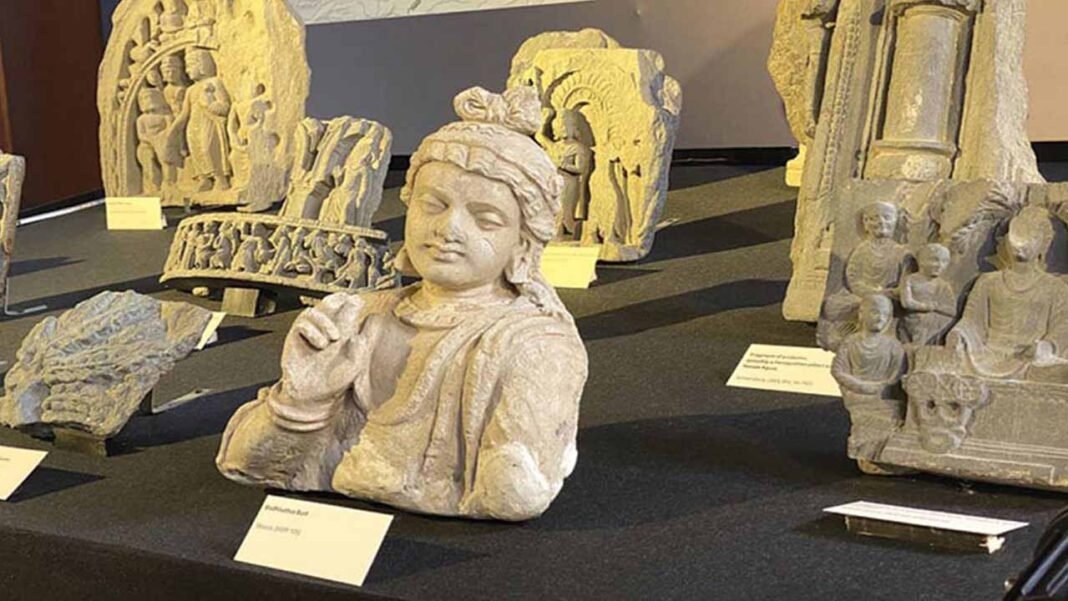
The museum’s greatest strength is its Gandhara collection. Also, the Buddhist civilization that flourished in what is now northern Pakistan and eastern Afghanistan produced some of the world’s most beautiful sculpture — serene Buddhas, intricate narrative reliefs, and delicate stucco figures — and the museum holds a fine selection. For visitors who have heard of Taxila but never made the trip, these galleries are the perfect introduction: the same art, the same stories, presented with care and context in the capital.
There is also a living, current reason to visit. In 2026 the museum opened its new Legacy Returns Home gallery, displaying more than 450 antiquities repatriated from the United States after being intercepted from illicit trafficking networks. Gandharan sculptures, relic caskets, a rare Indo-Greek gold coin, and terracotta figurines and painted pottery from Balochistan dating back to 7,000 BC. Seeing stolen heritage come home, beautifully displayed, is a genuinely moving experience and a reminder of why museums exist.
Finally, the Islamabad Museum is wonderfully accessible. Unlike the great archaeological sites of Taxila or Mohenjo-daro, which demand full-day excursions, this museum fits into any Islamabad itinerary — a morning here, lunch nearby. The Margalla Hills in the afternoon. For families, it is one of the capital’s best educational outings; for students of history, it is essential.
History of Islamabad Museum
The Islamabad Museum is young by museum standards — it was established in September 2002 — but it was built on decades of archaeological work. Also, it is an entity of the Federal Department of Archaeology and Museums, the government body responsible for Pakistan’s excavated heritage. Its creation gave the department’s vast stored collections a proper public home in the capital. The founding vision was ambitious: to tell the entire saga of the evolution of cultures and civilizations in Pakistan through artifacts displayed in chronological order, from the earliest stone tools to the arts of the Mughal period.
Older Than the Building
The collections themselves are far older than the building. The Soan Valley stone tools — dating back some two million years — come from one of the most important Paleolithic landscapes in South Asia, studied by archaeologists since the early 20th century. The 9,000-year-old objects from Mehrgarh in Balochistan represent one of the world’s earliest farming settlements, a precursor to the Indus Valley Civilization. The Indus artifacts connect the museum to Mohenjo-daro and Harappa, the great Bronze Age cities. The Gandharan sculptures belong to the Buddhist centuries (roughly the 1st century BCE to the 5th century CE) when Taxila, Takht-i-Bahi.
The Swat valley were centers of a civilization that carried Buddhism from South Asia to China. The Mughal-period astrolabes, miniature paintings, and manuscripts speak to the refined court culture of the 16th to 18th centuries.
In recent years the museum has grown in national prominence. Its director has championed the museum as a witness to Pakistan’s ancient connections with the wider world — including the remarkable artistic fusion visible in Gandharan “toilet trays” carved with Chinese dragon motifs. A fine collection of Chinese porcelain, probably 14th century, evidence of centuries of trade. The 2026 opening of the Legacy Returns Home gallery, following a Pakistan–US bilateral cultural agreement signed on January 30, 2024, marked the museum’s emergence as a stage for cultural diplomacy.
Under Federal Minister for National Heritage and Culture Aurangzeb Khan Khichi, the repatriation was celebrated as the return of “a part of Pakistan’s soul, history and civilisational identity.”
Top Things to Do in Islamabad Museum
Plan for two to three hours. The galleries are arranged chronologically, so follow them in order — the story builds beautifully.
Walk the Stone Age Gallery
Begin where humanity in this region begins: with the Soan Valley stone tools, some dating back two million years. These rough, hand-held implements are among the oldest human artifacts in South Asia, and standing before them is a humbling experience. You are looking at the work of hands that lived before language as we know it. Take your time here; the gallery sets the scale for everything that follows.
Meet Mehrgarh and the Indus Cities
The 9,000-year-old objects from Mehrgarh — pottery, tools, ornaments — tell the story of humanity’s turn to farming, the foundation of everything that followed. Then come the artifacts of the world-celebrated Indus Valley Civilization: the planned cities of Mohenjo-daro and Harappa, their seals, weights, and crafts, presented as the urban miracle they were. If you have ever wondered what “5,000 years of history” actually looks like, this is your answer.
Admire the Gandhara Collection
The heart of the museum for most visitors. The Gandharan Buddhist sculptures — serene stone Buddhas, stucco figures, and narrative reliefs carved with Greco-Roman influenced drapery — are masterpieces of ancient art. Also, look for the storytelling panels that depict episodes from the Buddha’s life, and for the smaller antiquities from Kot Diji and the Gandhara Grave Culture that show the region’s deeper roots. In fact, this is the art that once decorated the stupas and monasteries of Taxila and Swat.
Explore the Islamic and Mughal Galleries
The later galleries trace Pakistan’s Islamic heritage: early Muslim pottery, fine Chinese porcelain from centuries of trade, Mughal-period astrolabes (astronomical instruments of extraordinary precision), miniature paintings, and illustrated manuscripts. The illustrations of Pakistan’s historical monuments scattered through these rooms make a fine checklist for future travels — see how many you can tick off.
Visit the Legacy Returns Home Gallery
The museum’s newest gallery displays the 450+ antiquities repatriated from the United States: rare stone and stucco Buddhist sculptures, relic caskets, Gandharan narrative reliefs, a rare Indo-Greek gold coin, and 7,000 BC terracotta figurines and painted pottery from Balochistan. Also, each piece carries a double story — the ancient civilization that made it. In fact, the modern journey that brought it home. Allow extra time here; the labels are worth reading.
Famous Places In and Around Islamabad Museum
- Lok Virsa Heritage Museum — Pakistan’s great folk-heritage museum, a natural companion visit
- National Art Gallery — modern and contemporary Pakistani art
- Faisal Mosque — the capital’s iconic landmark, minutes away
- Margalla Hills National Park — hiking trails with city views for the afternoon
- Ban Faqiran Stupa — a real Gandharan Buddhist stupa on the capital’s edge; see our Ban Faqiran guide
- Bari Imam Shrine — historic Sufi shrine at the foot of the Margallas; see our Bari Imam guide
- Pakistan Monument and Museum — the national monument with its own heritage museum at Shakarparian
- Taxila — the great Gandharan archaeological complex, a day trip from Islamabad
How to Reach Islamabad Museum
Getting to the Islamabad Museum is straightforward. Also, it sits in the federal capital, well connected to every part of the twin cities. From anywhere in Islamabad, a ride-hailing car or taxi reaches the museum in 15–30 minutes depending on traffic. From Rawalpindi, allow 30–45 minutes. If you are staying in the Blue Area, Jinnah Super, or F-6/F-7 sectors, it is a short hop.
From Lahore: The drive to Islamabad takes about 4–5 hours via the M-2 motorway (around 375 km). Also, daewoo and other bus services run constantly between the cities. In fact, the museum is an easy taxi ride from any Islamabad bus terminal.
From Karachi: Fly to Islamabad International Airport (about 2 hours). Also, the museum is roughly 30–45 minutes from the airport by car. In fact, by train or bus, Karachi–Islamabad is an overnight journey. The railway station and bus terminals connect easily to the museum by taxi.
From within Islamabad: Ask your driver for the Department of Archaeology and Museums / Islamabad Museum. Also, combine it with nearby Lok Virsa and the National Art Gallery for a full culture day, and finish at Faisal Mosque or Daman-e-Koh for sunset. In fact, our Islamabad places guide has more itinerary ideas.
Route Details
- By air: Fly into Islamabad International Airport; take the metro bus or a taxi into the city center (30–45 minutes).
- By road from Lahore/Peshawar: M-2/M-1 motorways into Islamabad; follow signs to the city center and the museum’s sector.
- Local transport: Ride-hailing apps work reliably in Islamabad; agree on the destination (Department of Archaeology and Museums) before starting.
- Parking: Government museum buildings typically have visitor parking; confirm with the gate staff on arrival.
Where to Stay in Islamabad Museum’s Neighborhood
You will not stay at the museum. Also, Islamabad offers Pakistan’s best range of accommodation. In fact, the museum fits into any base. Luxury: the Serena and Marriott in the city center offer five-star comfort within 15–20 minutes of the museum. Mid-range: the F-6, F-7. In addition, Blue Area sectors are full of comfortable three- and four-star hotels and serviced apartments. The most convenient base for a culture-focused trip. Budget: guesthouses in G-6, G-7, and around Aabpara offer clean, affordable rooms. Rawalpindi (30–40 minutes away) has the cheapest options in the twin cities. For a museum day, base yourself anywhere central; Islamabad’s grid layout makes everything reachable.
Where to Eat: Local Foods Near the Museum
A museum morning deserves a good lunch. Also, Islamabad delivers. The capital’s food scene blends every regional cuisine of Pakistan. In fact, near the museum and the city center, Melody Market and Jinnah Super offer everything from Lahori chargha to Peshawari chapli kebabs, Kashmiri chai, and proper desi breakfasts of halwa puri and nihari on weekends.
For the authentic local experience, try chapli kebab and seekh kebab at the Peshawari restaurants clustered around the city, biryani and karahi at any good desi restaurant, and doodh patti or Kashmiri chai from a dhaba afterward. Meanwhile, Islamabad’s famous café culture — the F-6 and F-7 coffee houses — is perfect for an afternoon debrief after the galleries. A satisfying museum-day lunch runs roughly rs. 500–1,500 per person depending on how fancy you go. Dhaba meals are far cheaper.
Weather in Islamabad
Islamabad has four distinct seasons, and the museum is indoors — so weather matters less here than at outdoor sites. Still, pleasant weather makes the walk between the museum, Lok Virsa, and the Margallas far more enjoyable. Summers are hot and humid with monsoon rains; winters are cool and crisp; spring and autumn are glorious.
| Season | Temperature Range | Conditions |
|---|---|---|
| Winter (Dec–Feb) | Around 0°C to 15°C | Cool, crisp, often foggy mornings; pleasant afternoons — great museum weather |
| Spring (Mar–Apr) | Around 15°C to 28°C | The city’s best season; jacaranda and blossoms everywhere; ideal for combining the museum with outdoor sights |
| Summer (May–Jun) | Around 28°C to 40°C | Hot; the air-conditioned galleries are a welcome refuge at midday |
| Monsoon (Jul–Aug) | Around 25°C to 35°C | Heavy rains; lush and green but plan indoor-heavy days |
| Autumn (Sep–Nov) | Around 15°C to 30°C | Clear, golden, comfortable — the second-best season after spring |
Language and Culture of the Capital
Islamabad is Pakistan’s most cosmopolitan city. Urdu is the lingua franca and English is widely spoken — museum labels and guides are typically in both. You will hear Punjabi, Pashto, and every other Pakistani language in the city’s bazaars. Culturally, the capital is relatively relaxed: dress is modest but varied, photography inside the museum may be restricted in some galleries (ask the staff and respect the signs — flash is usually prohibited near delicate artifacts). The standard Pakistani warmth to visitors applies. Government museums generally observe Friday prayer breaks, so plan a midday pause.
Confirm current opening days and timings on the Department of Archaeology and Museums website (doam.gov.pk) before visiting, as public-holiday closures apply.
Shopping Near the Museum
No trip to the capital is complete without its craft markets. Jinnah Super and the Centaurus Mall cover modern shopping, but for heritage-flavored souvenirs head to Lok Virsa’s craft shops (right in the museum neighborhood) for truck art, blue pottery, camel-skin lamps. It embroidered textiles. Aabpara Market and Melody Market offer books, antiques, and everyday bargains. Look for Gandhara-inspired replicas — small Buddha figures and relief copies — as the perfect memento of your museum visit, alongside blue pottery from Multan and Peshawari chappals. Bargaining is expected in traditional markets but not in fixed-price craft shops.
Local Events and Festivals
The museum itself hosts temporary exhibitions through the year — the Legacy Returns Home show is the current highlight — so check DOAM’s announcements before your visit. In the surrounding cultural belt, Lok Mela, Lok Virsa’s great annual folk festival, usually takes place in November: ten days of craftspeople, folk musicians, and regional cuisines from all over Pakistan. The single best week of the year to be in Islamabad’s museum quarter. The Islamabad Literature Festival (usually winter/spring) and the capital’s spring Jashn-e-Baharan celebrations add further flavor if your dates align.
Travel Tips for Islamabad Museum
Packing Essentials
- A notebook or phone for notes — the chronological story is worth remembering
- Comfortable walking shoes; you will be on your feet for 2–3 hours
- A light jacket in winter; the galleries are climate-controlled but the walk between sites is not
- Water and a snack; museum cafeterias are not guaranteed
Safety Tips
- Islamabad is among Pakistan’s safest cities for tourists; standard urban awareness applies
- Carry your CNIC or passport — government buildings sometimes require ID at the gate
- Do not touch the exhibits; oils from hands damage ancient stone and pottery
- Keep valuables minimal; the museum is a calm, controlled environment
Money & Connectivity
- ATMs: Plentiful across Islamabad; carry small cash for tickets and the gift shop
- Tickets: Government museum entry fees are nominal; confirm current rates at the counter or on doam.gov.pk
- Mobile signals: All networks (Jazz, Telenor, Zong, Ufone) work well across the capital
- Photography: Ask at the entrance about the current camera policy; expect no-flash rules in artifact galleries
Best Time to Visit Islamabad Museum
Spring (March to April) — Ideal
The perfect museum-trip season: glorious weather for walking between the museum, Lok Virsa. Also, the Margalla viewpoints, with the city in full bloom. In fact, combine the galleries with an evening at Daman-e-Koh.
Autumn (October to November) — Excellent
Clear skies, comfortable temperatures, and Lok Mela in November make this the culture lover’s season. Also, the museum quarter is at its liveliest.
Winter (December to February) — Good
Cool, crisp days are ideal for indoor sightseeing; the galleries are a warm refuge on foggy mornings. Also, just note public-holiday closures around Eid and national days.
Summer and Monsoon (May to August) — Manageable
Hot and humid outside, cool inside — plan the museum for midday and save outdoor sights for morning or evening. Monsoon rains can disrupt travel plans, so keep the itinerary flexible.
Final Thoughts
The Islamabad Museum will not overwhelm you with size, and that is its gift. Also, in two or three unhurried hours, it gives you what a dozen textbooks cannot: the physical reality of Pakistan’s deep past, from two-million-year-old stone tools to the serene Buddhas of Gandhara to the treasures that have just come home. It turns the abstract idea of “5,000 years of history” into something you can stand in front of and touch with your eyes.
Pair it with Lok Virsa next door, lunch in Jinnah Super. Also, a sunset over the Margallas. In fact, you have one of the finest culture days in Pakistan — all without leaving the capital. Browse more ideas in our Explore Pakistan collection, or start planning the great northern journey with Hunza Valley.
FAQs
Where is the Islamabad Museum located?
The Islamabad Museum is housed in the building of the Federal Department of Archaeology and Museums in Islamabad, close to the city’s cultural belt near Lok Virsa, the National Art Gallery, and Faisal Mosque.
When was the Islamabad Museum established?
The museum was established in September 2002 as an entity of the Federal Department of Archaeology and Museums, to display Pakistan’s archaeological heritage in chronological order.
What can I see at the Islamabad Museum?
Two-million-year-old Soan Valley stone tools, 9,000-year-old Mehrgarh artifacts, Indus Valley Civilization objects, Gandharan Buddhist sculptures, Mughal-era astrolabes, miniature paintings and manuscripts, early Islamic pottery, Chinese porcelain. Also, the new Legacy Returns Home gallery of repatriated antiquities.
How much time do I need at the Islamabad Museum?
Two to three hours is enough for an unhurried visit through the chronological galleries, including the new repatriated-artifacts gallery. Add nearby Lok Virsa for a full culture day.
Is the Islamabad Museum good for children?
Yes — it is one of Islamabad’s best educational family outings. Also, the chronological layout, ancient tools, Buddha statues, and (for older kids) the story of stolen artifacts coming home are all engaging. In fact, keep the visit to 1–2 hours for younger children.
Can I take photographs inside the museum?
Policies vary by gallery; flash photography is typically prohibited near delicate artifacts. Also, Ask at the entrance about the current camera rules and always respect the signage.
What are the museum’s opening hours and ticket price?
As a government museum it generally opens on weekdays with nominal entry fees, but timings and holiday closures change — confirm current hours on the Department of Archaeology and Museums website (doam.gov.pk) before visiting, and note Friday prayer breaks.
What else can I combine with the museum in one day?
Lok Virsa Heritage Museum and the National Art Gallery (same neighborhood), lunch in Jinnah Super or Melody Market, Faisal Mosque, and sunset at Daman-e-Koh or the Pakistan Monument in Shakarparian.