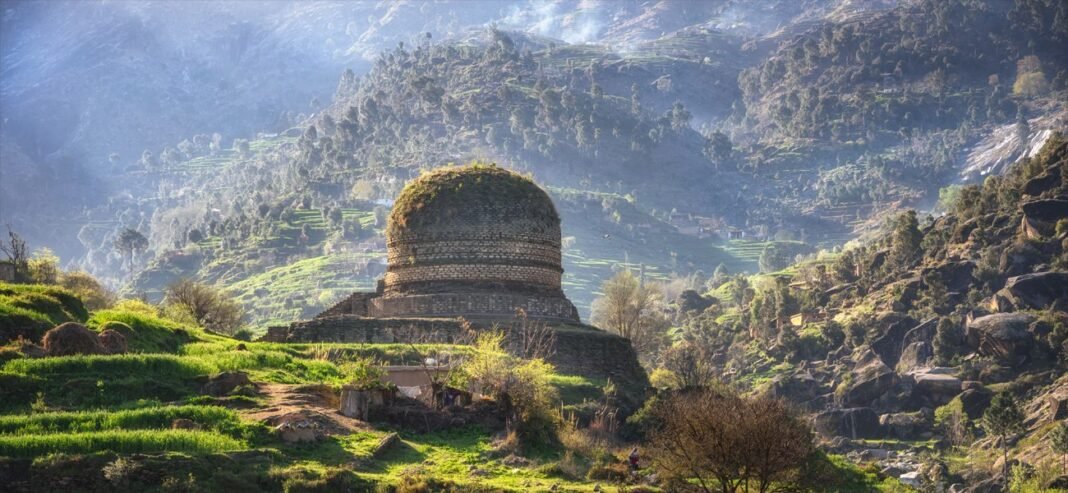
High on a cliff of Mount Tor Kamar, in the quiet Jambil Valley of Swat, stands one of the most haunting Buddhist monuments in Pakistan. The Jurjurai Stupa is built of finely cut gneiss — a square first storey, two circular levels, and a raised dome with stairways climbing its eastern face — and it has watched over this valley for some two thousand years. It is damaged, it is crumbling, and it is utterly unforgettable. If you want to experience the Gandhara civilization not as a museum exhibit but as a living ruin in a living landscape, Jurjurai belongs on your Swat itinerary.
Quick Facts
- Location: On a cliff of Mount Tor Kamar in the Jambil Valley, Swat District, Khyber Pakhtunkhwa, Pakistan
- Altitude: Hillside/cliff setting above the Jambil Valley floor (exact elevation unverified — the valley sits well above 1,000 m)
- Famous For: A finely masoned gneiss Buddhist stupa with quadrangular base, two circular levels and raised dome; its resemblance to the Loebanr stupa; dramatic cliffside setting
- Nearest City: Mingora (the main city of Swat, gateway to the side valleys)
- Accessibility: Reached via the Jambil Valley from the main Swat valley; final approach on foot over uneven terrain — a local guide is strongly recommended
- Known Landmarks: The stupa itself with its surviving dome section; the gneiss chattravali (umbrella) disc found nearby
- Best For: History lovers, Buddhist heritage pilgrims, photographers, trekkers, and off-the-beaten-path explorers
Why Visit Jurjurai Stupa, Swat
Swat is famous for its meadows and rivers, but its deepest magic is historical. Twenty-five centuries ago this valley was Uddiyana, one of the great centres of Buddhism — the land Chinese pilgrims like Fa-Hsien and Hsuan-tsang wrote about with awe, describing hundreds of monasteries and stupas. Most travelers see that heritage behind glass in the Swat Museum. At Jurjurai, you see it where it was built: a monumental stupa of hand-cut stone, alone on a cliff, with the whole Jambil Valley spread below.
What makes Jurjurai special among Swat’s many stupas is its architecture and its solitude. The masonry is exceptional — finely cut gneiss blocks laid with a precision that has survived two millennia of earthquakes, treasure hunters, and stone robbers. The design, with its square base, circular drum levels, and raised dome, closely mirrors the famous Loebanr stupa, marking it as a product of the mature Gandharan tradition. And because it sits off the main tourist circuit, you will likely have it entirely to yourself: just you, the wind, and two thousand years.
There is also an honest, urgent reason to come. Jurjurai is crumbling. Treasure hunting and stone quarrying have eaten into the structure, and heritage surveys warn that sections of the masonry are collapsing. Visiting respectfully — viewing from a safe distance, hiring a local guide, spending money in the nearby villages — is a small vote for the idea that this place matters. Heritage that nobody visits is heritage nobody protects.
Finally, Jurjurai is the perfect anchor for a deeper Swat journey. Pair it with the excavated Butkara stupas near Mingora, the great Amluk-dara stupa above Barikot, the rock-carved Buddhas of the valley, and the Swat Museum’s Gandharan sculpture halls, and you will leave understanding why this valley was once called the Switzerland of the East and the cradle of Gandharan Buddhism. Few single trips in Pakistan teach you so much.
History of Jurjurai Stupa, Swat
The Jurjurai Stupa belongs to the great Buddhist age of Swat — the era when this valley, known to the ancient world as Uddiyana, was one of the holiest lands of Buddhism. The Gandhara civilization, centred on the Peshawar valley and Taxila but extending deep into Swat, flourished from around the 6th century BCE. It passed through Achaemenid Persian rule (Swat was a province under Darius I, 522–486 BCE), fell to Alexander the Great in 327 BCE, returned to Indian rule under the Mauryans in 305 BCE, absorbed Indo-Greek Hellenistic influence from around 180 BCE, and reached its golden age under the Kushans in the 1st to 3rd centuries CE — when King Kanishka (circa 127–150 CE) made Buddhism a world religion and Gandharan art fused Greek, Persian, and Indian styles into something entirely new.
The stupas of Swat’s side valleys, including Jurjurai, were products of this long Buddhist centuries-long flowering. While Jurjurai itself has not been scientifically excavated and dated the way Butkara or Amluk-dara have, its architecture — the quadrangular medhi (base), the circular drum, the raised dome, the eastern stairway, the pilaster decoration — places it firmly in the mature Gandharan tradition, most likely the Kushan period or the centuries immediately after. A gneiss chattravali disc, the stone “umbrella” that once crowned the dome, was found near the stupa — a signature element of Gandharan stupa architecture. Scholars note its close resemblance in form and proportions to the stupa at Loebanr, another of Swat’s great monuments.
Buddhism in Swat did not vanish overnight. The Chinese pilgrim Hsuan-tsang, visiting in the 7th century CE, still found a thriving Buddhist culture. The religion declined gradually as Hindu Shahi rulers rose in the 9th century and Islam arrived in the centuries after — Mahmud of Ghazni’s campaigns reached the region in the early 11th century. The valley’s Buddhist monuments were then abandoned to fourteen centuries of weather, earthquakes, and — in recent decades — looters.
Modern archaeology came late to these side-valley stupas. The great Italian Archaeological Mission, founded by Giuseppe Tucci, excavated Swat’s flagship sites from the 1950s onward — Domenico Faccenna’s famous 1956–1962 excavation of Butkara I near Mingora revealed a stupa monumentalized with Hellenistic decoration in the 2nd century BCE and yielded thousands of sculptures. Jurjurai, remote on its cliff in the Jambil Valley, was surveyed rather than excavated, and it remains essentially as the centuries left it: magnificent, wounded, and waiting.
Top Things to Do in Jurjurai Stupa, Swat
See the Stupa from the Valley and the Cliff
The essential experience is simply being there. Approach through the Jambil Valley and the stupa reveals itself gradually — a stone crown on the cliff of Tor Kamar. Study the architecture up close (from a safe distance): the quadrangular first storey, the two circular levels including the drum, the surviving section of the raised dome, the eastern stairway, the pilaster carving in the gneiss. Then step back and take in the composition — ancient monument, cliff, valley, mountains. It is one of the most photogenic heritage sites in Swat.
Walk the Jambil Valley
The journey is half the reward. The Jambil is a classic Swat side valley — terraced fields, walnut and apricot orchards, traditional Pashtun villages, and the sound of water everywhere. The walk to the stupa passes through working farmland, so you will see rural Swat life up close: farmers in the fields, children on the paths, woodsmoke in the air. Go with a local guide, who will know the paths and can introduce you to villagers.
Build a Gandhara Circuit
Jurjurai is at its best as part of a multi-day Buddhist heritage trail. Combine it with Butkara I near Mingora — the great excavated stupa of the Italian mission (see our Butkara I travel guide); Amluk-dara above Barikot, one of the best-preserved stupas in the valley (see our Amluk-dara travel guide); the ancient city site of Bazira/Barikot (see our Barikot guide); and the rock-carved Buddhas at Jahanabad and Ghalegay. Four or five days gives you the full story.
Visit the Swat Museum, Saidu Sharif
Before or after the field sites, spend half a day at the Swat Museum on the Mingora–Saidu Sharif road. Its Gandharan sculpture halls — Buddhas, Bodhisattvas, and narrative panels excavated from the valley’s stupas — give you the visual vocabulary to read sites like Jurjurai. The seated Buddha statues here are among the finest in Pakistan.
Photograph Responsibly
Jurjurai rewards the patient photographer: dawn light on the gneiss, the stupa silhouetted against valley mist, the dome’s curve against the mountains. But remember the structure is fragile — never climb on the masonry, never move stones, and keep a respectful distance from collapsing sections. Your photographs should leave nothing behind but footprints on the path.
Famous Places In and Around Jurjurai Stupa, Swat
- Butkara I, Mingora — the great excavated stupa complex, centrepiece of Swat’s Buddhist heritage.
- Amluk-dara stupa, Barikot — a superbly preserved stupa about 1.5 hours from Mingora.
- Swat Museum, Saidu Sharif — the valley’s treasure house of Gandharan art.
- Jahanabad Buddha — the giant 7th-century rock-carved Buddha, one of South Asia’s largest.
- Malam Jabba — Swat’s ski resort and summer meadow escape (see our Malam Jabba guide).
- Bahrain and Kalam — upper Swat’s river valleys, trout streams, and alpine scenery (see our Bahrain travel guide).
How to Reach Jurjurai Stupa, Swat
Jurjurai is reached via Mingora, the main city of Swat, and then into the Jambil Valley — a side valley off the main Swat valley. The final approach is on foot over uneven terrain, which is why a local guide is not optional but essential: the paths are unmarked, the stupa sits on a cliff with collapsing masonry, and a guide keeps you safe while unlocking the valley’s stories.
From Islamabad: about 240–260 km via the Swat Motorway (M-16) and N-95, roughly 4 to 5 hours by car. The motorway has made Swat one of the most accessible northern destinations in Pakistan.
From Lahore: about 500–550 km via the motorway network through Islamabad, roughly 8 to 9 hours. Most travelers break the journey in Islamabad.
From Karachi: over 1,500 km — fly to Islamabad and drive, or fly to Peshawar and continue by road.
From Peshawar: about 170–190 km via the Swat Motorway, roughly 3 to 4 hours — the easiest gateway of all.
Nearest airport: Saidu Sharif Airport near Mingora has had intermittent service; the reliable options are Bacha Khan International Airport, Peshawar (about 170 km) and Islamabad International Airport (about 250 km). Daewoo and other coach services run frequently to Mingora from both cities.
Mingora to Jambil Valley: Hire a car or jeep with a driver in Mingora who knows the side valleys, and arrange your guide there too — hotel staff can connect you with reliable local guides. Expect a drive into the valley followed by a walk to the stupa site.
Route Details
- Islamabad → Mingora: M-1 to the Swat Motorway interchange, then M-16 to Chakdara and the N-95 into the Swat valley to Mingora. Well-signposted, 4–5 hours.
- Mingora → Jambil Valley: Local road into the side valley with your driver and guide. Road quality varies — a high-clearance vehicle is advisable.
- Valley → the stupa: On foot with your guide over farmland and hillside paths to the cliff of Mount Tor Kamar. Wear proper walking shoes, carry water, and stay back from the cliff edge and any collapsing masonry.
Visit in daylight only, and never attempt the walk in rain — the hillside paths get slippery and the cliffside setting demands respect.
Where to Stay in Jurjurai Stupa, Swat
Stay in Mingora/Saidu Sharif — the twin cities at the heart of lower Swat — which have the valley’s widest range of hotels. There is no tourist accommodation in the Jambil Valley itself; Jurjurai is a day excursion, not an overnight stop.
Mid-range hotels: Mingora’s main roads have plenty of comfortable mid-range hotels with hot water, heating, and restaurants. These are the practical base for a heritage-focused trip — well-located for the museum, Butkara, and the road into the side valleys.
Upper-range hotels: Saidu Sharif and the Fizagat area have some of Swat’s better hotels, with nicer rooms, lawns, and river views. Worth it if you are spending several days on a Gandhara circuit.
Budget guesthouses: Simple, clean guesthouses around Mingora cater to domestic travelers at very low prices. Fine for a night or two if you are keeping costs down.
What to look for: Heating matters — Swat nights are cold from October to March, and many budget places skimp on it. Confirm hot water and heating when booking in the shoulder seasons. In peak summer (June–August), book ahead; Mingora fills up.
Where to Eat: Local Foods of Jurjurai Stupa, Swat
Eat in Mingora before heading into the valley — the Jambil has village hospitality (and you should accept the tea) but no restaurants. Swat’s food is classic Pashtun mountain cooking, hearty and fresh.
Chapli kebab: Swat does an excellent chapli kebab — spiced minced beef or mutton patties fried crisp. The dhabas around Mingora’s bazaars serve them fresh all day.
Chicken and mutton karahi: The default celebratory dish, cooked fast in a wok with tomatoes, ginger, and green chilies. Order it fresh and eat it with hot naan.
Trout: In upper Swat (Bahrain, Kalam) the rivers yield excellent trout, usually pan-fried simply with salt and lemon. If your trip extends up the valley, do not miss it.
Dried fruits and honey: Swat’s apricots, mulberries, and walnuts — fresh in summer, dried year-round — plus local honey, are the edible souvenirs. Buy from Mingora’s bazaars.
Qehwa: Green tea, served everywhere, all day. In the villages around Jurjurai it will be offered within minutes of arrival — accept it warmly.
Meals are budget-friendly throughout Swat. Stick to busy places with high turnover, drink bottled water, and carry snacks and water for the Jambil Valley walk.
Weather in Jurjurai Stupa, Swat
Swat’s climate varies dramatically with altitude. The Jambil Valley sits in the lower-to-middle hills — warmer than Kalam but cooler than the Peshawar plains. The stupa walk involves exposed hillside paths, so weather matters: spring and autumn are ideal, summer is workable if you start early, and winter brings real cold to the valley.
| Season | Temperature Range | Conditions |
|---|---|---|
| Winter (Dec–Feb) | 0°C to 12°C | Cold, frosty mornings; occasional rain; snow possible on the higher slopes. Valley walks are crisp but chilly. |
| Spring (Mar–May) | 10°C to 28°C | Green valleys, blossoming orchards, comfortable walking weather. The best season for the stupa visit. |
| Summer (Jun–Aug) | 20°C to 35°C | Warm days, monsoon showers possible in July–August. Start the walk early morning. |
| Autumn (Sep–Nov) | 8°C to 25°C | Clear skies, golden foliage, excellent visibility. The second-best window after spring. |
Heritage surveys specifically recommend April–May or autumn for Jurjurai: dry paths, good light, and safe conditions for viewing the cliffside masonry from a distance.
Language and Culture of Jurjurai Stupa, Swat
The Jambil Valley is Pashtun country. Pashto (the Yusufzai dialect) is the language of daily life; in upper Swat you will also hear Torwali and Gujari. Urdu works in Mingora’s hotels and bazaars, but in the villages a Pashto-speaking guide transforms the experience — and the welcome.
Swat was a princely state until 1969, and the old Wali’s legacy of order and hospitality still colours the culture. The people are famously hospitable to guests, and the valley has worked hard to rebuild its tourism after the difficult years of militancy (2007–2009). Visitors today are received with genuine warmth — and a visible pride that travelers have returned.
Swat is conservative. Dress modestly, ask before photographing people (especially women), and accept hospitality graciously. If you are visiting a religious site — and a Buddhist stupa, however ruined, deserves that respect — keep voices low, do not climb on the structure, and leave everything as you found it. Your guide will also advise on local prayer times and customs.
Shopping in Jurjurai Stupa, Swat
Shop in Mingora’s bazaars — the Jambil Valley has no souvenir shops, and that is part of its charm.
Swat emeralds and gemstones: Swat is famous for its emeralds, mined in the valley for decades. Mingora’s gemstone dealers sell emeralds, quartz, and other local stones — buy only from reputable shops and get proper certification for anything expensive.
Woolen shawls and embroidery: Hand-loomed shawls, embroidered fabrics, and traditional caps are Swat bazaar staples. The quality of the woolens is excellent and prices are fair.
Dried fruits and honey: Apricots, mulberries, walnuts, and local honey — buy from the main bazaar for the best selection.
Books on Gandhara: Ask at the Swat Museum shop for publications on the valley’s archaeology — the perfect companion to a heritage trip.
Travel Tips for Jurjurai Stupa, Swat
Packing Essentials
Proper walking shoes with grip are mandatory — the paths to the stupa are uneven hillside tracks. Bring sun protection, a hat, drinking water, and snacks: there are no shops or facilities at the site. A light rain jacket is wise in the monsoon months, and warm layers are needed from October to March. Binoculars are a lovely extra for studying the stupa’s upper levels from a safe distance.
Safety Tips
The main safety considerations at Jurjurai are the terrain, not the people. The stupa stands on a cliff with collapsing masonry — view it from a safe distance, never climb on the structure, keep children close, and do not approach the cliff edge. Walk only with your local guide, in daylight, and in dry weather. Swat is welcoming to tourists today, but as everywhere in KP, keep your ID on you, share your plans with your hotel, and check current advisories before traveling.
Money & Connectivity
Bring cash in rupees — Mingora has banks and ATMs, but there are no ATMs in the Jambil Valley and village shops are cash-only. Mobile signals (Jazz, Telenor, Zong) work in Mingora and much of the main valley but fade in the side valleys; download offline maps and tell your hotel your plans before heading out. A portable charger is useful for a full day in the field.
Best Time to Visit Jurjurai Stupa, Swat
April to May — The Prime Window
The valley is green, the orchards are in blossom, temperatures are perfect for walking, and the light on the gneiss is beautiful. This is the single best time to visit Jurjurai.
June to August — Summer
Warm and busy — Swat’s peak tourist season. The stupa walk is very doable if you start early in the morning. Combine with upper Swat (Kalam, Mahodand Lake) for the full summer valley experience.
September to November — Autumn
Clear skies, golden foliage, fewer crowds, and superb photography conditions. The heritage-survey recommended window alongside spring.
December to March — Winter
Cold and quiet. Lower Swat rarely gets heavy snow, but the Jambil paths can be frosty and the stupa walk is less pleasant. Better for museum-and-bazaar days in Mingora than for the cliffside site — unless you catch a crisp, clear winter morning.
Final Thoughts
The Jurjurai Stupa is not a polished tourist attraction, and that is exactly its power. It is a two-thousand-year-old monument of hand-cut stone, standing alone on a cliff in a working valley, slowly losing its battle with time and treasure hunters. To visit is to witness Gandharan Buddhism not as history-book abstraction but as something you can touch with your eyes — and to understand, viscerally, why heritage needs visitors to survive.
Go in spring, walk the Jambil Valley with a local guide, stand a respectful distance from the old stones, and let the place tell you its story. Then carry that story home — to the Swat Museum, to your photographs, to everyone you tell. Places like Jurjurai endure when people remember them. For the rest of Swat’s wonders, explore our Explore Pakistan collection.
FAQs
Where is the Jurjurai Stupa located?
On a cliff of Mount Tor Kamar in the Jambil Valley, a side valley of Swat District, Khyber Pakhtunkhwa. It is reached via Mingora and a guided walk into the valley.
How old is the Jurjurai Stupa?
It has not been scientifically excavated, but its mature Gandharan architecture — square base, circular drum, raised dome, eastern stairway — places it in the great Buddhist centuries of Swat, most likely the Kushan period or the centuries after, roughly 1,700–2,000 years ago.
What is the best time to visit Jurjurai Stupa?
April–May and September–November, when the valley paths are dry and the weather is ideal for walking. Heritage surveys specifically recommend spring or autumn.
How do I reach Jurjurai Stupa from Islamabad?
Drive the Swat Motorway to Mingora (4–5 hours), then hire a car and a local guide for the Jambil Valley. The final approach to the cliffside stupa is on foot.
Is it safe to climb on the stupa?
No. The masonry is damaged and collapsing in places — view from a safe distance, never climb on the structure, and keep children away from the cliff edge.
Is Jurjurai suitable for families?
Older children who can manage a hillside walk will love the adventure; it is not suitable for toddlers or anyone unsteady on their feet. There are no facilities at the site.
Where should I stay?
In Mingora or Saidu Sharif, which have hotels for every budget. Jurjurai is a day trip — there is no accommodation in the Jambil Valley.
What else should I see nearby?
Butkara I, Amluk-dara stupa, the Swat Museum, the Jahanabad rock Buddha, and Malam Jabba — together they make a superb multi-day Gandhara circuit.