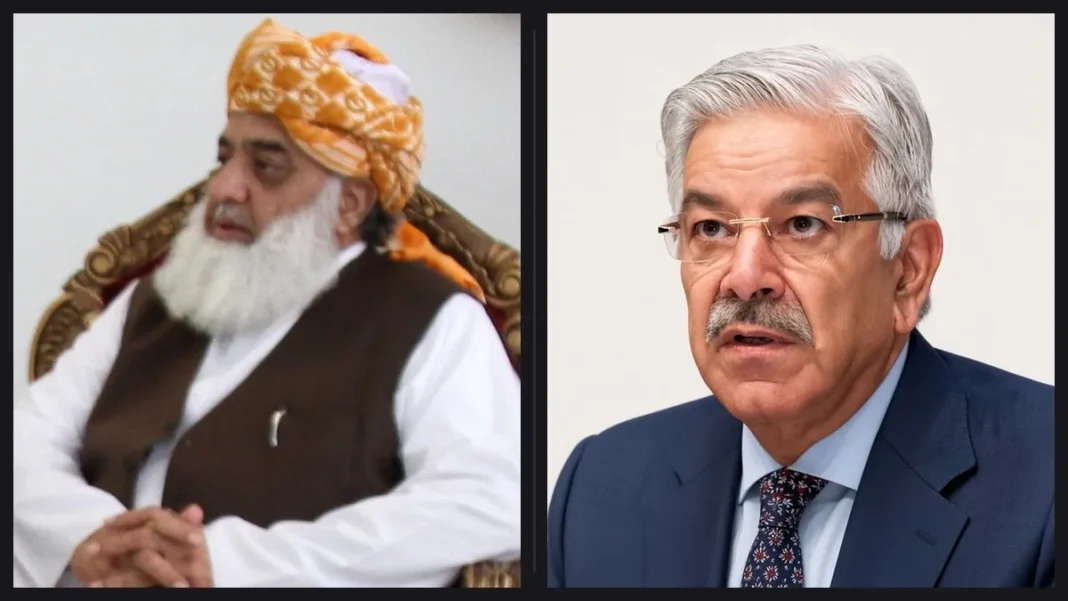
The Fazlur Rehman Asif remark in the National Assembly on Wednesday drew laughter in the House and spread quickly on social media, after the JUI-F chief turned Defence Minister Khawaja Asif’s own famous line back on him.
Maulana Fazlur Rehman told the House that a defence agreement was being made in Iran while Pakistan’s defence minister was sitting at home. He then addressed Asif directly, saying: “Khawaja Asif sahib is also present here. A defence agreement is being made in Iran, and the defence minister is sitting here.”
He followed it with Asif’s own well-known line: “Koi sharam hoti hai, koi haya hoti hai”, which translates as “Have some shame, have some decency”. A video shared by JUI-F Senator Kamran Murtaza has circulated widely online.
Fazlur Rehman Asif remark: the Tehran talks behind it
The remark referred to high-level talks held in Tehran on Monday, October 26. Chief of Defence Forces Field Marshal Asim Munir, Saudi Defence Minister Prince Khalid bin Salman, and Turkish intelligence chief Ibrahim Kalin met Iranian President Masoud Pezeshkian and other senior Iranian officials.
The three envoys represented the Makkah Joint Defence Agreement, a military alliance signed by Pakistan, Saudi Arabia, and Turkiye in August 2026. It was the pact representatives’ first meeting with Iranian leaders, focused on regional security and preventing fresh escalation.
Khawaja Asif said a day later that Pakistan would defend Saudi Arabia with full force under the pact. That statement, reported on October 27, set the context for the jibe: the minister had spoken publicly in support of the pact, but had not been part of the Tehran delegation.
Asif’s line has a long history in Pakistani politics. He famously used it in the National Assembly years ago to criticise PTI lawmakers, and it has since become one of the most quoted lines in the country’s politics. Social media users noted it may be the first time the line has been used against Asif himself, with him sitting in the House.
A wider speech, not just a jibe
Fazlur Rehman’s speech went beyond the remark about Iran. During the same speech, he called on the government and the opposition to sit together and draw up a new Charter of Democracy.
That call fits a broader theme in his recent speeches: negotiation and compromise as basic principles of politics. In a separate report of the same session, he said the opposition had responded positively when the government sought talks, seeking a meeting with PTI founder Imran Khan and arrangements for his medical treatment, but the government later refused those demands.
The speech also carried a sharper edge. Fazlur Rehman said the country had no functioning government or constitution in practice, and that the state should treat its citizens with care rather than confrontation. His party’s spokesperson later reacted strongly to the reported blackout of his speech on television, calling it an insult to Parliament and freedom of expression.
Why the exchange matters
On the surface, the exchange was parliamentary theatre: a veteran opposition leader used a famous line against the minister who made it famous, and the House laughed. Underneath, it touched a real question about the Makkah pact, which binds Pakistan to Saudi Arabia’s defence. Its first meeting with Iran involved the chief of defence forces, a Saudi prince, and a Turkish intelligence chief, but not Pakistan’s civilian defence minister or prime minister.
That does not prove a rift, since defence diplomacy often runs through military channels. But it explains why an opposition leader could turn the absence into a talking point.
The exchange also shows how the pact is now part of domestic debate, not just foreign policy. Asif presents it as a binding commitment to defend Saudi Arabia. Fazlur Rehman questions the process around it, while calling for dialogue at home.
Feature Pakistan earlier reported on Khawaja Asif saying Pakistan will defend Saudi Arabia against any threat and on regional unity talks in Tehran.
Frequently asked questions
What did Fazlur Rehman say to Khawaja Asif?
He said a defence agreement was being made in Iran while the defence minister was sitting in the House, then turned Asif’s own line, “Koi sharam hoti hai, koi haya hoti hai”, back on him.