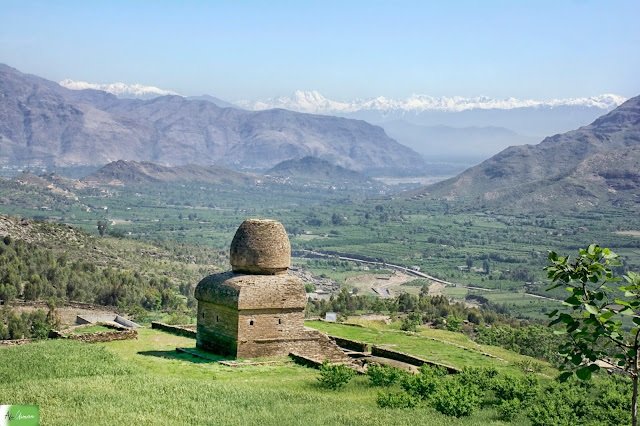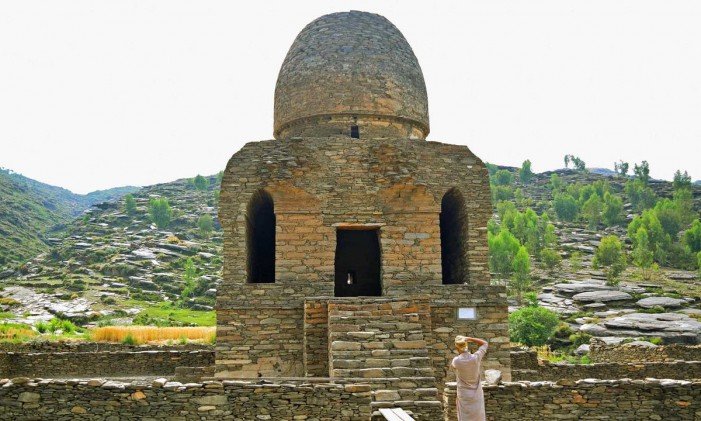
Some places in Pakistan reward the traveler who goes looking for them. The Gumbat Stupa is one of those places — a 2nd-century Buddhist monument standing on a broad terrace in the Kandag Valley, about nine kilometers south of Barikot in Swat, its double-domed cupola rising over a cluster of more than twenty smaller stupas. There is no ticket office, no crowd, no souvenir shop. Just you, the wind moving through the valley, and one of the best-preserved stupas of ancient Uddiyana — the Buddhist heartland the Greeks called Udyana and the Chinese pilgrims called a land of monasteries. This Gumbat Stupa Barikot travel guide will tell you why this quiet ruin deserves a detour, how it fits into the great story of Gandhara, and how to reach it.
Quick Facts
- Location: Kandag Valley, about 9 km south of Barikot (Birkot), Swat District, Khyber Pakhtunkhwa
- Altitude: Valley floor, around 700–800 meters above sea level
- Famous For: A 2nd-century CE Buddhist stupa with a rare double-domed cupola, a 17-meter square plinth, and more than 20 surrounding votive stupas
- Nearest City: Barikot town (~9 km); Mingora about 20 km away
- Accessibility: Reached by road from Barikot; accessible year-round, easiest by private car or hired vehicle from Mingora
- Known Landmarks: The main double-domed stupa, the votive stupa field, remains spread over 1,500 by 1,000 meters of terraced fields
- Best For: History lovers, archaeology enthusiasts, photographers, travelers exploring Gandharan Buddhist heritage, quiet off-beat stops
Why Visit Gumbat Stupa, Barikot
Swat’s famous stupas — Amluk-Dara, Butkara, Shingardar — get the visitors. Gumbat gets the silence, and for many travelers that is exactly the point. Stand on the terrace with the main stupa beside you and the smaller stupas scattered across the fields, and you are looking at a sacred complex much as the monks of the Kushan era left it: unadorned, monumental, and utterly still. The double-domed cupola is genuinely unusual in Gandharan architecture, and archaeologists consider this one of the best-preserved stupas of ancient Uddiyana. You will not find that combination anywhere else in Swat.
The setting does half the work. The Kandag Valley opens in wide terraced fields that slope up toward the Shamozai hills, with a spring in a picturesque gully north of the sacred area. In spring the terraces are green and the light is soft; in autumn the whole valley turns gold. It is the kind of landscape that explains, without any words from a guide, why Buddhist monks chose this exact spot for a monastery complex two thousand years ago.
Gumbat is also perfect for a particular kind of traveler: the one who has already seen Swat’s headline sights and wants the deeper layer. Pair it with ancient Bazira at Barikot, the Swat Museum’s Gandharan galleries, and the other valley stupas, and you will leave with an understanding of Buddhist Swat that goes far beyond the standard tour. Come for the history, stay for the solitude — and bring a camera, because the stupa against the hills at late afternoon is one of the great under-photographed views in Khyber Pakhtunkhwa.
History of Gumbat Stupa, Barikot
To understand Gumbat, you have to understand where it stands. Swat was known in ancient times as Uddiyana (Udyana), one of the great centers of Buddhism in the northwestern subcontinent and a core region of the Gandharan civilization. The valley sat on the trade crossroads between India, Central Asia and the Middle East, and from the Mauryan period onward — Ashoka’s empire reached here in the 3rd century BCE — it filled with monasteries and stupas. The Chinese pilgrims Faxian and Xuanzang, who traveled through in the 5th and 7th centuries CE, described Swat as a land of hundreds of monasteries and stupas.
The Gumbat Stupa belongs to the mature phase of this Buddhist civilization. Radiocarbon dating of the structures confirms they were built in the 2nd century CE, during the era of the Kushan Empire — the great Buddhist-supporting power whose most famous king, Kanishka, convened a Buddhist council and under whose rule Gandharan art reached its peak. The stupa and its monastery were part of a sacred landscape that also included the great city of Bazira at Barikot, conquered by Alexander the Great in 327 BCE and later excavated by the Italian Archaeological Mission from 1984 onward.
The modern rediscovery of the site began with Sir Aurel Stein, the Hungarian-British archaeologist who first recorded Gumbat in 1930 in the Memoirs of the Archaeological Survey of India, identifying the main stupa and its votive stupas. Small-scale excavations followed — by Barger and Wright, and later by Professor Giuseppe Tucci of the Italian mission in 1955–56. The most thorough recent work came in 2011, when archaeologists excavated about a quarter of the site’s terrace; radiocarbon results from that campaign anchored the 2nd-century date. Restoration work in 2011–2012 stabilized the ruins, and the site is today marked as a protected archaeological site under Khyber Pakhtunkhwa’s Antiquities Act, managed by the provincial Directorate of Archaeology and Museums — though, like many of Swat’s monuments, it would benefit from more sustained conservation.
One honest note for travelers: you will sometimes see the names “Gumbat” and “Gumbatuna” used interchangeably in older writing — “gumbatuna” is simply the plural of the Pashto word “gumbat,” meaning dome. This guide follows the Kandag Valley site nine kilometers south of Barikot, the restored double-domed stupa also marked in some records as the Balo Kalay Stupa of Swat.
Top Things to Do in Gumbat Stupa, Barikot
Walk the Main Stupa Terrace
The lower zone of the complex is dominated by the main stupa: a square plinth 17 meters on each side with an offset projection, rising through a dome and drums to the remains of a harmika and umbrellas. The structure’s signature feature is its double-domed cupola — two domes, one above the other — a form rarely seen in Gandharan architecture and the reason the stupa is considered among the best preserved of ancient Uddiyana. Walk the full circuit of the terrace; the scale only becomes clear when you are standing at its base looking up.
Explore the Votive Stupa Field
More than twenty smaller stupas surround the main monument, scattered across the terrace and the fields beyond. These votive stupas were built by devotees over generations, and wandering among them gives you the real sense of a living pilgrimage place rather than a single isolated monument. Look for carved fragments and masonry details — but leave everything exactly where you find it.
Read the Landscape
The archaeological remains spread over roughly 1,500 meters by 1,000 meters of terraced fields sloping into the hills behind, known as the Shamozai range. A spring sits in a gully north of the sacred area. Take the time to climb a little above the complex and look back: the whole sacred geography — stupa, monastery terraces, fields, hills — falls into place, and you will understand the site the way its builders did.
Photograph the Stupa at Golden Hour
Late afternoon light rakes across the masonry and throws the domes into sharp relief against the hills. The site’s openness means there is nothing blocking your angles. Mornings are softer and emptier; evenings are more dramatic. Either way, this is one of Swat’s most photogenic ancient sites, and you will likely have it to yourself.
Famous Places In and Around Gumbat Stupa, Barikot
- Bazira (Barikot) — the ancient fortified city conquered by Alexander in 327 BCE, excavated by the Italian mission since 1984.
- Amluk-Dara Stupa — Swat’s most famous stupa, beautifully set above the valley near Mingora.
- Butkara-I Stupa — the great excavated stupa complex near Mingora, dug by the Italian mission.
- Buddha Footprints (Buddhapada) — the ancient engraved footprints discovered by Stein, another treasure of the Barikot area.
- Ghalegay Buddha — the rock-carved seated Buddha, a short detour in the valley.
- Swat Museum, Saidu Sharif — the essential companion visit: Gandharan sculptures from Gumbat and across the valley, including excavated reliefs.
- Malam Jabba — Swat’s ski resort and alpine escape, an easy pairing for a multi-day trip.
How to Reach Gumbat Stupa, Barikot
The stupa sits in the Kandag Valley south of Barikot town, and every route runs through Barikot first. From Barikot, a local road heads south into the valley; the site is signposted locally, but asking in town is the reliable method — say “Gumbat Stupa” or “Balo Kalay Stupa” and you will be pointed the right way. The last stretch is a village road, passable by car in dry weather.
From Islamabad: About 235 km, roughly 4–4.5 hours. Take the M-1 motorway, exit at the Colonel Sher Khan Interchange onto the Swat Motorway (M-16), continue to the Chakdara interchange, then follow the N-95 toward Barikot. This is one of the smoothest mountain approaches in Pakistan thanks to the motorway.
From Lahore: About 480 km via the M-1 and Swat Motorway, roughly 7–8 hours. Most travelers break the journey or travel via Islamabad.
From Karachi: Around 1,700 km by road — fly to Islamabad, then drive. The nearest airport with regular commercial flights is Islamabad International; Saidu Sharif airport near Mingora has only limited, intermittent service.
Transport options: A private car or rented vehicle with a driver is by far the easiest way to reach the site, because the final approach is a rural road with no public transport. From Mingora, hire a car or jeep for the day and combine Gumbat with Barikot’s other sites. Daewoo and other coach services run Islamabad–Mingora; from Mingora’s bus stands, local vans go to Barikot, from where you will need a private arrangement for the last kilometers.
Route Details
Islamabad → M-1 (Peshawar motorway) → Colonel Sher Khan Interchange → M-16 Swat Motorway (81 km of tunnels and bridges, with the Katlang rest area) → Chakdara Interchange → N-95 along the Swat River → Barikot town → south on the Kandag Valley road → Gumbat Stupa site. The motorway section is fast and modern; the Chakdara–Barikot stretch is a good two-lane road; the final valley road is narrow but fine for cars outside the monsoon. Fuel up in Chakdara or Barikot — there are no fuel stations in the valley itself.
Where to Stay in Gumbat Stupa, Barikot
Nobody stays at the stupa — you base yourself in Barikot town or, better, in Mingora/Saidu Sharif about 20 km away, which has Swat’s full range of accommodation.
Luxury: The Swat Serena Hotel in Saidu Sharif is the valley’s landmark upscale stay — set in lawns and gardens, about 5 km from downtown Mingora, with the Buddhist sites of the valley an easy drive away. Book ahead in peak season (May–August).
Mid-range: Mingora’s main roads are lined with mid-range hotels aimed at domestic tourists — clean, comfortable, and usually including breakfast. This is the sweet spot for most heritage travelers: good value and a short drive to both Gumbat and the Swat Museum.
Budget and guesthouses: Barikot town has simple guesthouses, and Mingora has budget hotels near the bus stands. They are basic but perfectly serviceable for travelers who spend their days at the sites.
If your trip is purely about the Buddhist heritage, staying in Mingora or Saidu Sharif keeps you within easy reach of Gumbat, Amluk-Dara, Butkara and the museum in a single well-planned day.
Where to Eat: Local Foods of Gumbat Stupa, Barikot
There are no restaurants at the stupa — eat in Barikot town or Mingora before or after your visit, and carry water and snacks for the site itself.
Swati food is hearty Pukhtun fare. The essentials: chapli kebab (the minced-meat patty Swat does superbly), lamb or chicken karahi cooked in its own fat and tomatoes, tikka and malai boti from the roadside grills, and kabuli pulao with its sweet carrot-and-raisin topping. Maize and wheat breads come fresh off the tawa, and no meal ends without qehwa — Swat’s green tea, sometimes flavored with cardamom. Mingora’s restaurants also serve trout, brought up from the colder upper valley, and the bazaars are full of dry fruits, walnuts and honey from the surrounding hills.
A full dhaba meal in Barikot or Mingora typically costs a few hundred rupees per person — generous, filling, and one of the genuine pleasures of traveling in Khyber Pakhtunkhwa. Eat where the locals eat; the busiest grill is usually the best one.
Weather in Gumbat Stupa, Barikot
Barikot sits on the valley floor, so its climate is milder than upper Swat but warmer than most visitors expect. Winters are cool and mostly dry with occasional frost; summers are hot on the open terrace — there is no shade at the stupa, so plan around the sun. The monsoon (July–August) brings the year’s heaviest rain and can make the valley road muddy.
| Season | Temperature Range | Conditions |
|---|---|---|
| Winter (Dec–Feb) | 2–14°C | Cool and dry; frosty mornings, clear days. Good for site visits with warm clothing. |
| Spring (Mar–May) | 12–30°C | Pleasant and green; the best season for photography and walking the terraces. |
| Summer (Jun–Aug) | 20–36°C | Hot on the exposed terrace; monsoon rain heaviest in August. Visit early morning. |
| Autumn (Sep–Nov) | 10–28°C | Clear, golden, comfortable — arguably the finest season for the valley. |
Language and Culture of Gumbat Stupa, Barikot
The valley’s people are Yusufzai Pashtuns, and Pashto is the language of daily life; Urdu is widely understood, especially by younger people and in the towns. Swat’s culture runs on the Pukhtun code of hospitality — guests are honored, and you will likely be offered tea more than once on any heritage walk through the villages.
For visitors, the norms are straightforward: dress modestly (cover shoulders and knees; women should carry a headscarf for village areas), ask permission before photographing people, and treat the stupa as what it is — a sacred archaeological site, not a climbing frame. Do not remove stones, carve initials, or move fragments; the Directorate of Archaeology protects the site, and the local community takes pride in it. A local guide from Barikot, if you can arrange one, will enrich the visit enormously and put money directly into the village economy.
Shopping in Gumbat Stupa, Barikot
There is nothing to buy at the stupa — and that is as it should be. For souvenirs, head to Mingora’s bazaars: Swati embroidered shawls and waistcoats, handwoven woolen items, carved wooden boxes, and the valley’s famous gemstones (Swat emeralds have been mined here since antiquity). Dry fruits, walnuts, wild honey and dried apricots make excellent edible souvenirs. Bargain politely and with a smile — it is expected and enjoyed on both sides.
Travel Tips for Gumbat Stupa, Barikot
Packing Essentials
Sun protection is critical — the terrace has no shade, so bring a hat, sunglasses and sunscreen even in spring. Sturdy walking shoes for the uneven masonry and terraced fields. Carry drinking water and snacks; there are no shops at the site. A camera with a zoom lens is ideal for architectural details, and a power bank helps on long site days.
Safety Tips
Swat is a settled, tourist-friendly valley and the Barikot area sees regular domestic tourism. Still, travel in daylight, keep to the site and village roads, and let your hotel know your plans. The masonry is ancient — watch your footing on the terraces and do not climb the stupa itself. Mobile coverage is decent around Barikot town but can drop in the valley folds.
Money & Connectivity
Carry cash in Pakistani rupees — there are no ATMs or card facilities anywhere near the site. ATMs are available in Barikot town and plentiful in Mingora. Jazz and Telenor have the most reliable signals in the valley; Zong also works in the towns. Download offline maps before you leave Mingora.
Best Time to Visit Gumbat Stupa, Barikot
Spring (March–May) — the finest season
Green terraces, wildflowers, soft light, comfortable temperatures. The stupa photographs beautifully and the valley road is in its best condition. This is the season to choose if you can.
Autumn (September–November) — the golden season
Clear skies, harvest colors, crisp air. October in particular combines perfect walking weather with dramatic light on the masonry. The year’s second-best window.
Winter (December–February) — quiet and clear
Cold mornings but brilliant clear days, and you will almost certainly have the site to yourself. Bring warm layers; the wind on the open terrace bites.
Summer (June–August) — visit early
Hot and, in July–August, rainy. If you must come in summer, arrive at opening light, finish by mid-morning, and spend the afternoon at the Swat Museum instead.
Final Thoughts
The Gumbat Stupa is not the kind of place that shouts for attention. It rewards the traveler who has done a little homework, driven a little further, and walked a little slower. In return it offers something increasingly rare: a great monument of the Buddhist world, standing in its original landscape, with no crowd between you and it.
If you are building a Gandhara itinerary through Swat — Bazira’s walls, the museum’s sculptures, the valley’s stupas — then Gumbat belongs on it, not as an afterthought but as a highlight. Come in spring, come at golden hour, and stand for a while on that terrace. Two thousand years of devotion are built into those stones, and on a quiet afternoon, you can feel every year of it. For more ideas across the region, browse our Explore Pakistan collection.
FAQs
Where is Gumbat Stupa located?
In the Kandag Valley, about 9 km south of Barikot town in Swat District, Khyber Pakhtunkhwa — reached by road from Barikot.
What is the best time to visit Gumbat Stupa?
March to May and September to November offer the best weather — green or golden landscapes, clear skies and comfortable temperatures for walking the site.
How do I reach Gumbat Stupa from Islamabad?
About 235 km via the M-1 motorway and the Swat Motorway (M-16) to Chakdara, then the N-95 to Barikot — roughly 4–4.5 hours. From Barikot, take the local road south into the Kandag Valley; a private car or hired vehicle is the practical option.
Is Gumbat Stupa safe to visit?
Yes. The Barikot area is settled and tourist-friendly. Visit in daylight, stick to the site and village roads, and let your hotel know your plans, as with any rural heritage site.
Is Gumbat Stupa suitable for families?
Yes, with supervision — children enjoy the open space and the adventure of the ruins, but the masonry is uneven and there is no shade, so bring water, hats and snacks.
Where can I stay near Gumbat Stupa?
Base yourself in Mingora or Saidu Sharif (about 20 km away), which has everything from the Swat Serena Hotel to mid-range hotels and budget guesthouses. Barikot town has simple guesthouses.
What food is available near Gumbat Stupa?
Nothing at the site itself — eat in Barikot or Mingora. Expect chapli kebab, lamb karahi, tikka, kabuli pulao and Swati qehwa at dhabas and restaurants for a few hundred rupees per person.
What is special about the Gumbat Stupa’s architecture?
Its double-domed cupola — two domes stacked — is rare in Gandharan architecture. The main stupa stands on a 17-meter square plinth and is surrounded by more than 20 smaller votive stupas, making it one of the best-preserved stupas of ancient Uddiyana.