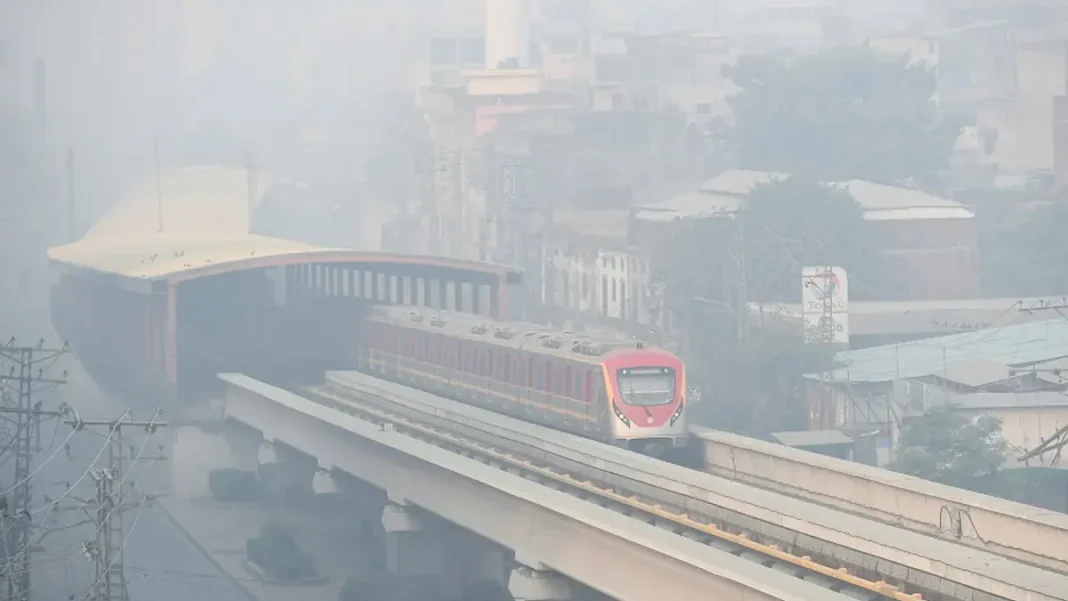
Lahore topped the world’s major-city pollution ranking on Monday, with the Lahore AQI crossing 600 into the hazardous band, while several other Punjab cities also recorded dangerous air.
IQAir put the Lahore AQI at 590, while an hourly reading on the same platform showed 647 during the morning, Dawn reported. In the live global ranking for major cities between 9am and 10am, Lahore sat at the top, ahead of Ulaanbaatar at 177, Delhi at 174, Kolkata at 173 and Sarajevo at 170, more than three times the level of the second-ranked city.
Some neighbourhoods fared worse than others. IQAir’s station ranking put Allama Iqbal Town at 1,033, the CERP Office at 864 and Burki Road Paragon at 748.
IQAir’s real-time ranking for Pakistani cities put Raiwind at 688, Multan at 655, Lahore at 639 and Faisalabad at 600, all in the hazardous band.
Why the Lahore AQI turned hazardous
A day earlier, the Punjab government had warned that smoke from Diwali fireworks in Indian Punjab, crop-residue burning and easterly winds could make the air worse in Lahore and nearby districts.
A special report from the provincial government on November 8 had predicted smoke from Diwali fireworks could reach Lahore within five to 13 hours. It forecast higher pollution in Lahore, Kasur and border areas on the morning of November 9, with easterly winds expected to carry polluted air from Indian territory towards Pakistan.
Amritsar, about 50 kilometres from Lahore, was named as a possible source of cross-border pollution, though the report said a measurement-based assessment would be needed to work out how much came from across the border.
Fires on both sides of the border
The Punjab government’s report counted 2,347 crop-residue burning incidents in Indian Punjab up to November 4, with 1,081 of them in Tarn Taran, Ferozepur and Amritsar, the three districts opposite Lahore and Kasur.
Satellite data, though, shows farm fires are also a major problem on the Pakistani side. An analysis by Hamari Hawa using NASA’s VIIRS satellite data found 13,241 fire detections in Pakistani Punjab, against 3,158 in Indian Punjab, between October 1 and 29. The Pakistani side had more than four times as many detections, and 92 per cent of those in Pakistani Punjab were on farmland.
A separate analysis covering October 15 to November 1 counted 7,130 crop-associated fire detections within 100 kilometres of Lahore on both sides of the border, including 781 within 40 kilometres of central Lahore. Sheikhupura led the districts with 322 detections, followed by Tarn Taran with 149 and Amritsar with 106.
The figures cut against a simple blame game. Smoke does cross the border, but the satellite record shows that most of the fire activity near Lahore sits on the Pakistani side.
Punjab’s crackdown on stubble burning
The Environment Protection Agency (EPA) Punjab counted 679 agricultural fire incidents across the province, of which 650 had been put out. The agency said it had stepped up its crackdown on stubble burning with night squads, drones, tractor-mounted fire bowsers and Quick Response Units in farming hotspots.
The Punjab Climate Watch Hub was using satellite-based fire-anomaly detection to spot vulnerable locations and alert district field teams for checks on the ground and firefighting. EPA Director General Abdullah Nayyar Sheikh has told regional directors and field teams to give anti-stubble-burning operations priority, and he has carried out surprise checks along motorways and main roads.
What the health numbers say
In Lahore, the nighttime PM2.5 concentration had already hit 202 micrograms per cubic metre before Diwali, the provincial government’s report noted. Air pollution ranks as the second-leading risk factor for deaths worldwide, claiming an estimated 8.1 million lives a year, according to global health statistics.
Lahore has topped global pollution rankings before. The city was named among the world’s worst for ozone pollution in a European report this year, and a UN report has warned that heatwaves in Punjab threaten agriculture and food security. Farmers in Tharparkar are already waiting on a relief package after drought hit their crops, and Sindh recorded a 50.8 per cent monsoon rainfall deficit in 2026.
What happens next
The Environment Protection Department’s comparative findings, due on November 10, will show how much of the smog came from fireworks, farm fires and local emissions. A slight improvement is expected from November 11, but enforcement against stubble burning will decide how bad the coming weeks get.
Frequently asked questions
What was Lahore’s AQI on November 9?
Lahore’s air quality index reached 590 on IQAir, with an hourly reading of 647, making it the world’s most polluted major city.
Which areas of Lahore had the worst air?
Allama Iqbal Town recorded 1,033, the CERP Office 864 and Burki Road Paragon 748.
Which other Punjab cities recorded hazardous air?
Raiwind recorded 688, Multan 655, Lahore 639 and Faisalabad 600 in IQAir’s real-time ranking for Pakistani cities.
What caused the spike in pollution?
Smoke from Diwali fireworks, crop-residue burning and easterly winds, the Punjab government said. Satellite data recorded 13,241 fire detections in Pakistani Punjab between October 1 and 29, against 3,158 in Indian Punjab.
When is the air expected to improve?
The government forecast that pollution levels would remain high on November 9 and 10, with a slight improvement expected from November 11.