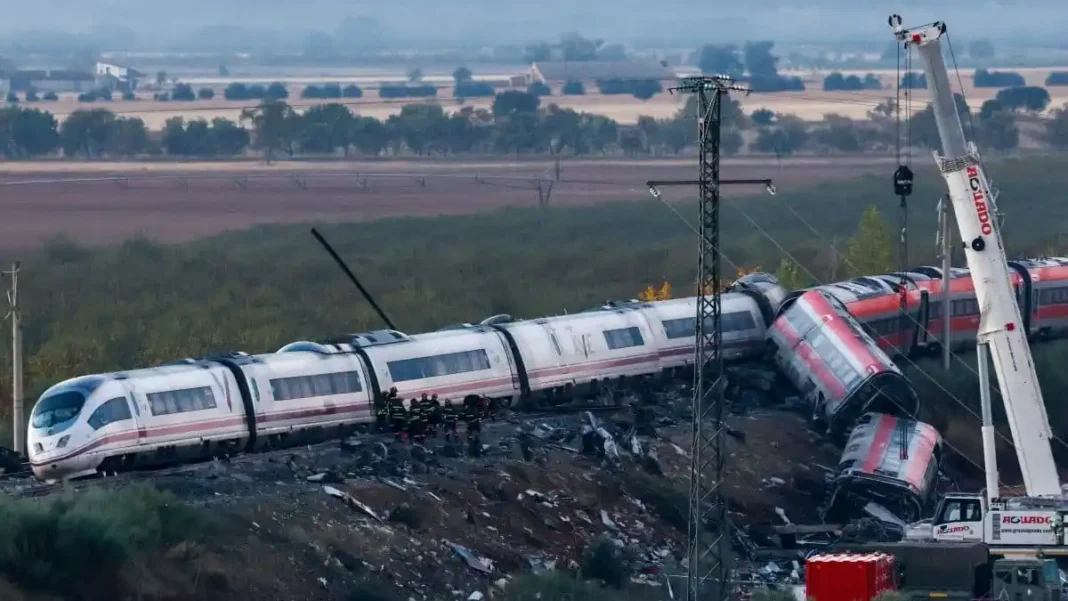
Spain Train Crash Toll Revised to 69
Spain has revised the death toll from its high-speed train crash to 69, after its transport accident investigation authority corrected an earlier figure of 74. The Spain train crash toll changed on Thursday, October 30, as the country began three days of national mourning for the victims.
The crash happened on Wednesday morning, October 28, near the village of Urda in Toledo province, about 130 kilometres south of Madrid. A Renfe service bound for Seville struck the rear of a stationary Iryo train on the same track. The Renfe train carried nearly 400 passengers, and the Iryo train carried 152 people.
Spain’s independent transport accident investigation authority, AITAT, first published a preliminary figure of 74 deaths on the transport ministry website at around 5:00 pm local time. It later corrected the figure to 69. That revised number matches the count announced earlier on Thursday by Emiliano Garcia-Page, the president of the Castilla-La Mancha regional government.
Spain train crash toll: how the figure moved
The toll has moved several times since the crash, and each revision has mattered to families waiting for news. Feature Pakistan reported the toll at 68 in its previous update, after earlier reports put the figure at 64 and then at 30 in the first hours. The jump to 74 came from a preliminary official posting, not from a final count, and the correction to 69 now settles the figure at the regional government’s number.
Regional authorities said another body was found at the crash site on Thursday, which took the count from 68 to 69. At the same time, officials said 50 injured people were still in hospitals in Castilla-La Mancha, while 60 had been discharged. Fifteen patients remained in a critical condition, although four of them were showing signs of improvement.
In Toledo, relatives gave DNA samples to the Civil Guard to help identify victims. The city received 52 bodies, which overwhelmed a morgue built for 30, so the army set up a temporary facility. Among the dead was Fatima Banez, a former labour minister for the main conservative Popular Party, according to the country’s CEOE business association.
Spain train crash toll: what caused the collision
Investigators are still establishing the exact chain of events, but the transport minister has already described a serious failure in the signalling system. Transport Minister Oscar Puente said an automatic control system known as LZB failed at around 8:30 am on Wednesday. The failure forced six trains on a 69-kilometre stretch of track to stop, including the two trains involved in the crash.
Control of rail traffic passed to the Madrid control centre, which authorised the Renfe train to resume its journey despite the signalling failure. Puente called that decision inexplicable, since a red signal should have kept the train stationary while the Iryo service remained on the same track ahead. The Renfe train then travelled 25 kilometres before striking the Iryo train, according to the minister’s account.
Both trains had left Madrid’s Atocha station bound for Seville. The Iryo service departed at 7:54 am, and the Renfe service followed six minutes later. The collision happened at 8:53 am local time on a straight stretch of track.
Prime Minister Pedro Sanchez visited the disaster site and pledged a full investigation to establish every detail of the tragedy and to strengthen safety measures so it never happens again. King Felipe VI also visited injured people in Toledo and called for measures to ensure such a crash does not happen again.
Spain train crash toll: mourning, strike and a second crash in months
Train drivers also went on strike on Thursday to demand improved safety. The drivers’ union Semaf had called the strike before the accident, to defend rail safety, and its head, Diego Martin, warned against focusing only on finding culprits while workers used degraded systems. Renfe reported a major impact on minimum services, with 26.6 per cent of the staff concerned joining the action.
The crash is Spain’s deadliest rail disaster since a derailment near Santiago de Compostela killed 80 people in 2013. It is also the country’s second rail tragedy this year: in January, a collision between two high-speed trains on the same Madrid to Andalusia line, near Adamuz, killed 46 people.