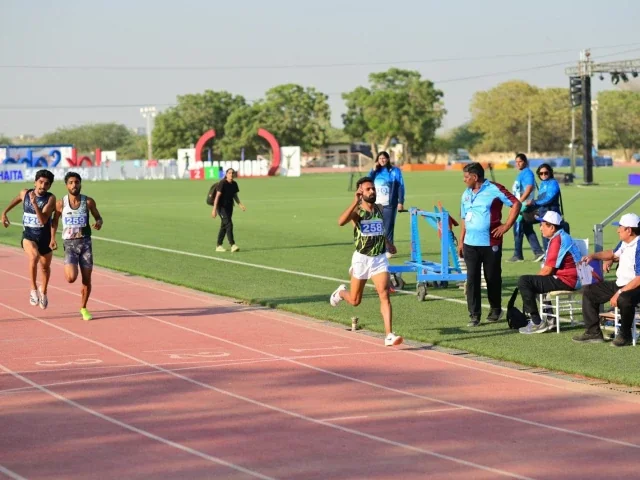
WAPDA Win National Athletics Championships
WAPDA emerged as overall champions of both the men’s and women’s sections of the 54th National Athletics Championship, winning 27 gold medals. Maria Bibi set a national record in the women’s 5,000 metres on the final day at NED University in Karachi.
WAPDA finished atop the overall standings with 17 gold medals in the men’s events and ten in the women’s competition. Navy finished second overall with nine golds, while the Higher Education Commission (HEC) took third place with eight golds.
A record that stood for 14 years
Maria Bibi clocked 19 minutes and two seconds to win the women’s 5,000m, breaking the previous national record of 19:04.05 set by Olympian Rabia Ashiq in 2012. The old mark had stood for 14 years, which makes Maria’s run the standout performance of the championship.
WAPDA’s Nazia Ehsan took silver in 19:49.50, while HEC’s Goonish Batool finished third in 20:10.80. The gap between first and second shows how clear Maria’s win was. She finished more than 47 seconds ahead of the silver medallist, a margin that is rare in a national 5,000m final.
Records of this kind matter beyond one race. A national record that survives for 14 years becomes a benchmark for a whole generation of runners. Breaking it shows that the current group of athletes is moving past that benchmark, and it gives younger runners a new target to aim for.
Sprint and field highlights
WAPDA’s sprinter Shajar Abbas won the men’s 200m in 20.75 seconds, ahead of Khyber Pakhtunkhwa’s Attaullah, who clocked 20.90. HEC’s Haseeb Ahmed took bronze in 21.40. HEC’s Khaula Umar Khan claimed the women’s 200m title in 24.80 seconds, with Sindh’s Iqra Riaz second and WAPDA’s Malaika Shehzadi third.
Navy’s Usman Ghani won the men’s high jump with 1.96 metres, while WAPDA’s Sohail Amir took the men’s 5,000m title in 15:16.20. Navy secured gold in the men’s 4x100m relay in 42.00 seconds, while WAPDA won the women’s event in 48.63.
WAPDA also claimed victories in the men’s triple jump and hammer throw, alongside several field events. Navy’s Amtil Rehman was among the standout performers, winning four gold medals, while Shajar collected three.
The championship was held under the supervision of the Athletics Federation of Pakistan and organised by the Sindh Athletics Association, with support from Lok Sahaita.
What WAPDA’s dominance shows
WAPDA’s tally of 27 gold medals was three times Navy’s total of nine. That gap is the clearest sign of how the championship played out. WAPDA did not win on the back of one event or one athlete. The department won across sprints, distance races, relays and field events, in both the men’s and women’s sections.
Departmental teams such as WAPDA, Navy and HEC form the backbone of athletics in Pakistan. They employ athletes, give them regular competition and keep them in the sport after their student years. A championship result like this one is therefore also a measure of which departments are investing in their athletes at present.
For the athletes themselves, the next step is to turn national success into regional and international results. A national record is a strong starting point. The test now is whether performances like Maria Bibi’s can be repeated against stronger fields outside Pakistan.
Related: Pakistan beat Bangladesh in Asian Games cricket final | Pakistan beat India in Asian Games volleyball semi-final | India beat Pakistan in Asian Games hockey semi-final | Babar Azam throws fan phone in pitch invasion
Frequently asked questions
Who won the 54th National Athletics Championships?
WAPDA won both the men’s and women’s sections, with 27 gold medals in total, 17 in men’s events and ten in women’s events.
What national record did Maria Bibi break?
She won the women’s 5,000m in 19 minutes and two seconds, breaking the previous national record of 19:04.05 set by Olympian Rabia Ashiq in 2012.
Where was the championship held?
The final day took place at NED University in Karachi, under the supervision of the Athletics Federation of Pakistan.
Who finished second and third overall?
Navy finished second with nine gold medals, and the Higher Education Commission took third place with eight golds.