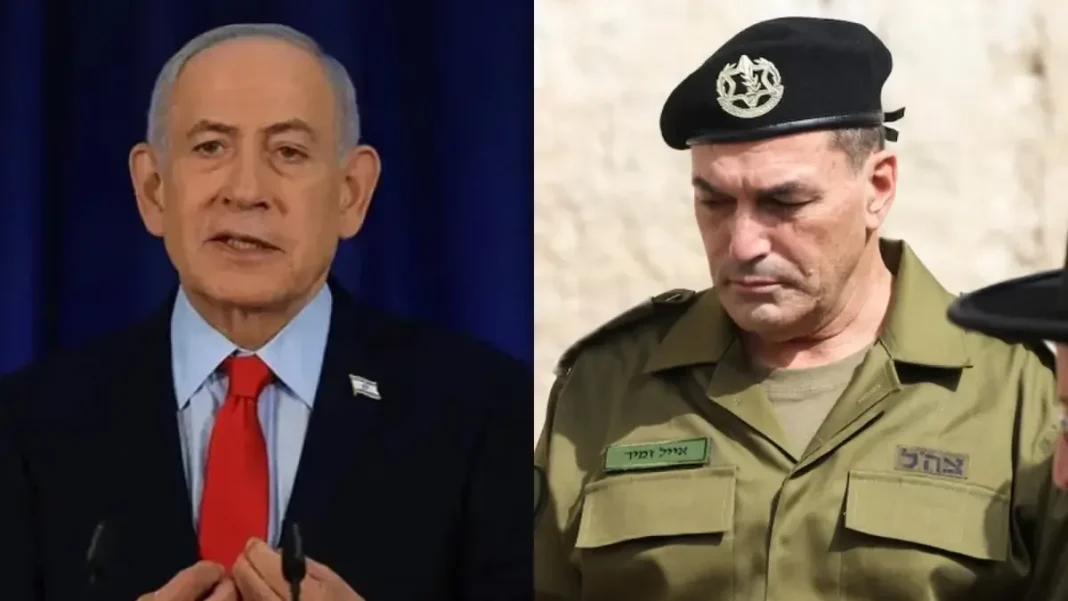
Netanyahu denies clash with Israeli army chief Eyal Zamir over a proposed military operation that could trigger fighting with Iran, just days before Israel’s parliamentary election on October 27. The denial came in an interview on Sunday, after Israel’s Channel 12 reported a dispute between the two men.
Channel 12 reported that Zamir asked for a detailed discussion and signed legal authorisation from political leaders before carrying out their instructions. The broadcaster did not disclose the nature of the operation. It said military officials feared the operation could rapidly escalate into a confrontation with Iran and lead to a miscalculation at a sensitive time.
Netanyahu rejected that account on Channel 14 later on Sunday. “There is no confrontation,” he said. Political officials also rejected the claim that the Iran issue was being used for electoral gain, according to Channel 12.
Netanyahu denies clash: what Channel 12 reported
The Channel 12 report, as carried by Dawn, said Zamir sought a full discussion and written legal authorisation before acting. It said the concern inside the military was twofold: first, that the operation could escalate quickly; second, that political leaders could exploit tensions with Iran for electoral gain before the October 27 vote.
A security official cited in the report warned that the operation could lead to a dangerous miscalculation. The report did not say what the operation involved, where it would take place, or whether Iran itself was the direct target.
The Times of Israel, also citing Channel 12, described the reported dispute as an unprecedented confrontation between the political leadership and the Israel Defense Forces. It said Zamir had resisted carrying out an unspecified order and sought written documentation of its legal authorisation. Netanyahu, in response, called the report nonsense in his Channel 14 interview.
What Netanyahu said in response
Netanyahu’s denial was direct, but his interview also contained a separate and striking claim. He said he had instructed the Mossad intelligence agency and the military to work toward toppling Iran’s government. Channel 12 did not establish whether the undisclosed operation was connected to those instructions.
Netanyahu also claimed Iran had resumed its nuclear programme, and he portrayed the election as a matter of Israel’s survival. Earlier on Sunday, he posted an AI-generated image of a nuclear explosion over Tel Aviv, alongside a warning about Iran obtaining nuclear weapons. Opposition leaders Gadi Eisenkot and Yair Golan accused him of spreading fear and panic before the vote.
In addition, United States President Donald Trump has urged Israelis to re-elect Netanyahu and to press ahead with the military campaign against Iran. Trump reaffirmed that support on Sunday.
Why the timing matters
Israel votes on Tuesday, October 27, one day after this report. Any claim about a military operation, a dispute with the army chief, or a nuclear threat lands in the middle of a campaign, and voters will hear it in that context. That is why both sides of the story matter: the report, and the denial.
The dispute also raises a wider question about civil-military relations in wartime. When an army chief asks for written legal authorisation, he is asking for a clear record of who ordered what, and on what legal basis. When a prime minister denies a dispute, he is trying to show unity at the top.
For readers outside Israel, the story also connects to the wider regional picture. Qatari mediators have been working on the Iran file, and Trump has said he will not strike Iran on Sunday while still pressing for a deal.
What to watch next
The election itself will be the first test. If Netanyahu wins, he will claim a mandate for his approach to Iran. If he loses, the dispute will be read as part of a campaign that failed to convince voters. Either way, the question of what operation was discussed, and whether it goes ahead, will remain.
The second test is whether any further detail emerges about the operation. Channel 12 has not disclosed its nature, and Netanyahu has not described it. Until that changes, the story should be reported as a reported dispute and a denial, not as a confirmed clash.