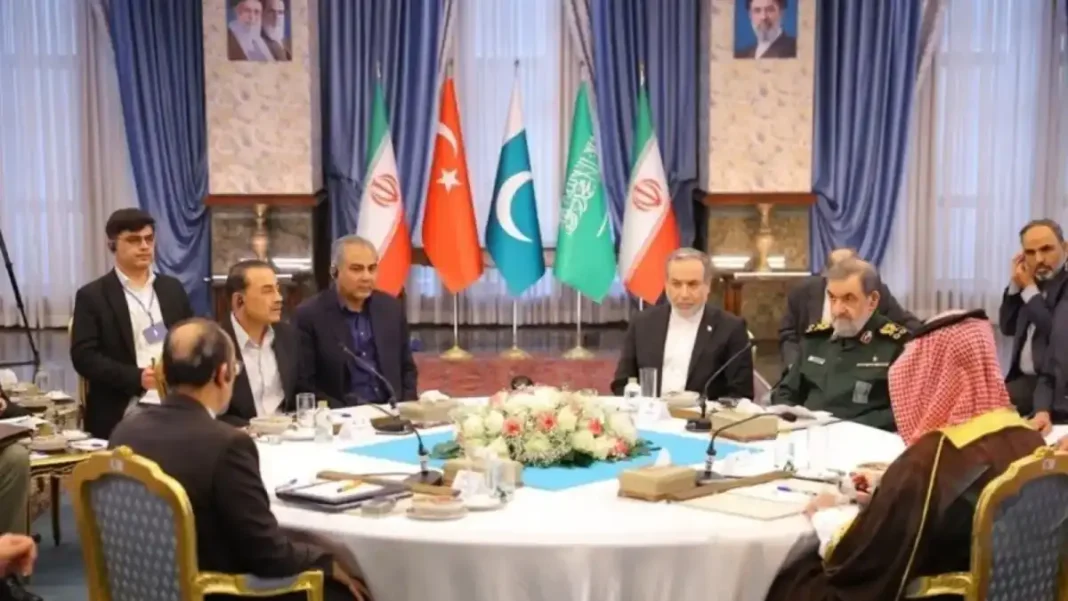
The Tehran regional unity meeting ended on October 26 with a promise to keep talking, after Iranian President Masoud Pezeshkian urged Islamic countries to stand together and adopt a coordinated position. Representatives of Pakistan, Saudi Arabia and Turkiye met Iranian officials in Tehran, in the first gathering of its kind since the Makkah defence pact was signed in August.
Pezeshkian told the meeting he hoped the presence of representatives of important and influential Islamic countries would help consolidate regional unity and cohesion. The remarks, shared on the Iranian presidential website, set the tone for the session.
What the Tehran regional unity meeting agreed
Iranian state television reported that the four countries agreed to continue discussions to strengthen cooperation, including on regional peace and security. No joint statement with detailed commitments was published, but the agreement to meet again was itself the main outcome.
Iran’s state broadcaster IRIB shared video of the session, showing officials seated beneath the flags of Iran, Turkiye, Pakistan and Saudi Arabia. Iran’s president sat with Foreign Minister Abbas Araghchi and security chief Mohsen Rezaei, while Saudi Defence Minister Prince Khalid bin Salman and Turkiye’s intelligence chief Ibrahim Kalin attended for their countries.
Why Pakistan was at the table
Pakistan was represented by Field Marshal Asim Munir and Interior Minister Mohsin Naqvi; ISPR had confirmed earlier in the day that Munir was visiting Tehran, without further details.
Feature Pakistan reported that senior officials from Saudi Arabia, Pakistan and Turkiye travelled to Tehran for talks aimed at lowering tensions in the Middle East. A second report noted that Munir would attend the joint meeting alongside senior Saudi and Turkish officials.
Pakistan’s place at the table matters because Islamabad has played a mediation role in the crisis. Saudi Deputy Minister for Public Diplomacy Rayed Krimly described the visit as part of continued efforts by Makkah Defence Alliance members for de-escalation, and said it supported mediation efforts carried out by Qatar and Pakistan. Pakistan also condemned Houthi attacks on the Makkah and Madina regions, as Feature Pakistan covered earlier on October 26.
Iran’s foreign ministry spokesperson, Esmaeil Baqaei, said the meeting would cover the most pressing issues threatening the region, including Israel’s expansionist policies and developments in Palestine and Lebanon. He said the top priority was the consequences of the United States-Israeli aggression against Iran.
The wider crisis behind the talks
The meeting took place against a war that has engulfed the Middle East since late February, when the United States and Israel launched surprise attacks on Iran just as Washington and Tehran were in the middle of negotiations on Iran’s nuclear programme. An April ceasefire ended the first phase of intense bombardment, but the two sides have kept contesting control of the Strait of Hormuz, through which around a fifth of the world’s oil and liquefied natural gas travels.
Diplomatic efforts have stayed stalled since the collapse of a June deal that laid out a pathway to a permanent settlement. The war has since spread to fighting between Saudi Arabia and the Houthis in Yemen, which in turn has drawn in other regional states. Egypt approved military support for Saudi Arabia after Houthi attacks escalated, underlining how far the conflict has widened.
Monday’s talks were the first high-level contact between Iran and all members of the Makkah Defence Alliance since Saudi Arabia was drawn deeper into the conflict. Under the Makkah pact, signed in August, an armed attack on one member is considered an attack on all.
Ali Bagheri Kani, deputy secretary of Iran’s top security body, framed the visit as part of efforts to build what Tehran calls endogenous security in West Asia: security shaped by regional states themselves. Baqaei said the meeting was suggested during Munir’s visit to Tehran last week.
What happens next
No date for the next round was announced. The test is whether dialogue lowers Gulf tensions, where Hormuz shipping stays at risk.
For Pakistan, the stakes are direct: a wider Gulf war would hit energy supplies, remittances and trade.
Who attended the Tehran meeting?
Iranian President Masoud Pezeshkian hosted officials from Pakistan, Saudi Arabia and Turkiye, including Field Marshal Asim Munir, Interior Minister Mohsin Naqvi, Saudi Defence Minister Prince Khalid bin Salman and Turkiye’s intelligence chief Ibrahim Kalin.