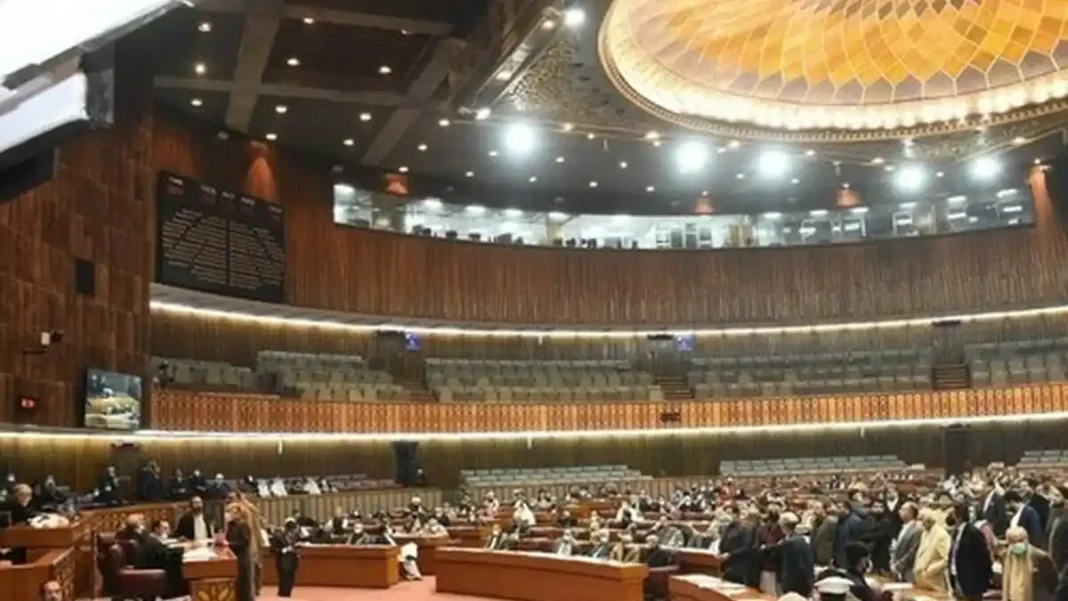
NA Adopts Resolution Saying Workplace Harassment Goes Beyond Sexual Conduct
The National Assembly on Friday approved a resolution reaffirming that workplace harassment is not limited to conduct of a sexual nature but may also include intimidation, humiliation and gender-based discrimination. The workplace harassment resolution was presented by MNA Dr Shahida Rehmani, who is also the secretary of the Women’s Parliamentary Caucus.
The resolution reaffirmed Parliament’s commitment to protecting the dignity, equality and rights of every individual against all forms of workplace harassment and gender-based discrimination, in line with Articles 14 and 25 of the Constitution. Article 14 covers the inviolability of the dignity of man, while Article 25 covers the equality of citizens.
It stressed that workplace harassment may manifest through gender-based discrimination, intimidation, humiliation, degrading treatment, hostile behaviour and misuse of authority, whether sexual or non-sexual in nature. The absence of a sexual advance or demand, the resolution said, does not diminish the seriousness of gender-based harassment or discrimination.
What the workplace harassment resolution asks institutions to do
The resolution reaffirmed the legislative intent and protections in the Protection against Harassment of Women at the Workplace Act, 2010, as amended in 2022. That amended law expressly recognises discrimination based on gender, both sexual and non-sexual, as falling within the statutory framework of harassment.
Through the resolution, the National Assembly called on the federal government and all concerned institutions to ensure the effective implementation of existing legislation in its full scope. The point is direct: no individual should be deprived of statutory protection merely because the harassment or gender-based discrimination reported was non-sexual in nature.
The resolution said the dignity of individuals “cannot be subjected to narrow distinctions between different forms of harassment” and that all conduct falling within the scope of the law “must be addressed with equal seriousness, fairness and accountability”. It concluded by reaffirming that a workplace free from harassment, humiliation and gender-based discrimination is “not a privilege, but a fundamental requirement of human dignity, equality and justice”.
Why the resolution was moved now
The resolution did not refer to any specific incident. Even so, its timing follows recent concern among lawyers and journalists about a ruling by the Federal Constitutional Court (FCC), in which the court set aside an Islamabad High Court judgement in a workplace harassment case filed by a National Bank of Pakistan employee in 2012.
Authored by Justice Ali Baqar Najafi, the FCC order reproduced the definition of harassment stated in the 2010 Act. That definition covers unwelcome sexual advances, requests for sexual favours, and other verbal, written or physical conduct of a sexual nature, or sexually demeaning attitudes, that interfere with work performance or create an intimidating, hostile or offensive work environment, or attempts to punish a complainant for refusing such a request.
Interpreting that definition, the FCC ruling said that an act, conduct or attitude has to be sexual in nature if it is to be covered under the definition of harassment for the purpose of the 2010 Act. That reading sits uneasily with the 2022 amendment, which expressly brought non-sexual gender-based discrimination within the law’s scope. Friday’s resolution does not change the law or overrule a court. It restates Parliament’s own intent: that the protections in the amended law cover the full range of harassment and discrimination, not only the sexual kind.
For workers, the practical question is what happens when a complaint is filed. A resolution urging full implementation puts the onus on employers, inquiry committees and government departments to treat non-sexual complaints with the same seriousness as sexual ones, rather than turning them away at the door. Readers looking for the legal background can read Feature Pakistan’s guide to the workplace harassment law in Pakistan.
The original report on the resolution was published by Dawn.
Who presented the resolution?
MNA Dr Shahida Rehmani, secretary of the Women’s Parliamentary Caucus, presented the resolution in the National Assembly.
What does the resolution say about harassment?
It says workplace harassment is not limited to sexual conduct and may include gender-based discrimination, intimidation, humiliation, degrading treatment, hostile behaviour and misuse of authority.
Does the resolution change the law?
No. It reaffirms the intent of the Protection against Harassment of Women at the Workplace Act, 2010, as amended in 2022, and urges the government and institutions to implement it in full.