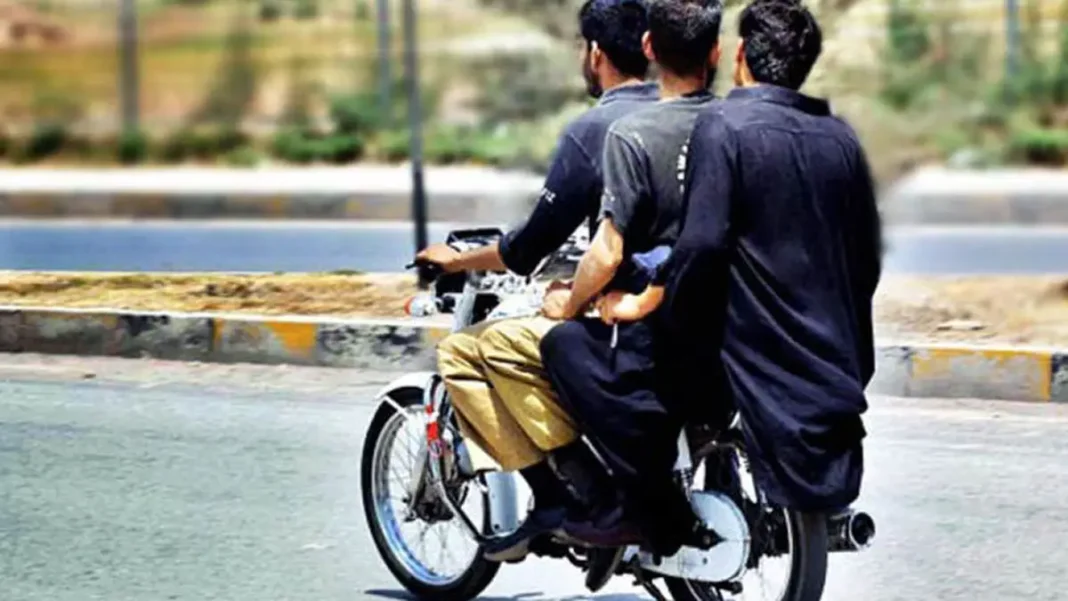
Bajaur bans pillion riding for 10 days on security fears
The district administration in Bajaur has banned pillion riding for 10 days, citing the security situation in the Khyber-Pakhtunkhwa district. The ban was imposed on Thursday by invoking Section 144 of the Code of Criminal Procedure (CrPC).
The notification was issued by the office of Deputy Commissioner Adnan Farid. It said the measure followed reports from intelligence agencies and the police department.
Given the prevailing security situation and the possible use of motorcycles in terrorist activities, immediate preventive measures were needed, the notification said. The deputy commissioner recorded that he was satisfied there were sufficient grounds to proceed under Section 144 as an immediate preventive measure to ensure public safety, avert any untoward incident and maintain law and order in the district.
What the ban covers
The ban on pillion riding took effect immediately. It will remain in place till 7 November unless the order is modified or withdrawn earlier.
Anyone who violates the order can be punished under Section 188 of the Pakistan Penal Code, which covers disobedience to an order duly promulgated by a public servant.
Pillion-riding bans are a standard tool in areas facing militant threats. Two people on a motorcycle can move quickly, strike and disappear into traffic. Removing the second rider makes that kind of attack harder to carry out and easier for police to spot.
A second ban in under two months
This is not the first time Bajaur has taken this step. Earlier, the authorities imposed a 15-day ban on pillion riding in the district on 5 September, citing the security situation at that time as well.
The repeat ban shows how persistent the threat remains in the district. Bajaur sits in the former tribal belt along the Afghan border, an area where militant groups have long operated and where security forces carry out regular operations.
For residents, the ban is a daily inconvenience. Motorcycles are the cheapest form of family transport in much of the district, and a pillion ban means extra trips, extra fuel or a walk. The administration’s calculation is that the inconvenience is worth the reduction in risk.
The wider violence picture
Khyber-Pakhtunkhwa has been facing terrorist attacks and security challenges for a long time. A recent report from the Centre for Research and Security Studies shows the trend getting worse, not better.
Pakistan recorded a sharp 83 per cent increase in violence-linked fatalities during the third quarter of 2026, reversing a declining trend seen in the first and second quarters. Terrorism and counter-terrorism deaths surged across the country in that period.
Balochistan and Khyber-Pakhtunkhwa remained the epicentres of violence, jointly accounting for 98 per cent of all fatalities during the quarter. Balochistan recorded 829 deaths, nearly 59 per cent of the national total. Khyber-Pakhtunkhwa reported 556 fatalities, accounting for more than 39 per cent.
Those figures give the Bajaur order its context. A district-level ban is a small measure, but it is being taken in the province that, with Balochistan, bears almost the entire human cost of the current wave of violence.
What happens next
The order runs till 7 November. The district administration can extend it, modify it or withdraw it earlier depending on how the security situation develops.
Residents will watch for two things: whether the ban is enforced evenly, and whether it is lifted on time. Temporary security measures that linger past their stated end date erode public trust. Measures that end when promised, and return only when the threat returns, are easier for communities to accept.
For now, the message from Bajaur’s administration is clear. The threat is specific enough, and the preventive step simple enough, that a 10-day restriction is the proportionate response.
Related coverage:
- https://featurepakistan.com/ghost-employees-dir-bajaur-health-education-action-october-2026/
- https://featurepakistan.com/ecp-orders-kp-local-polls-12-districts-excluded-october-2026/
- https://featurepakistan.com/shehbaz-kp-apex-committee-rs160bn-uplift-funds/
How long does the Bajaur pillion-riding ban last?
The ban took effect immediately on 29 October 2026 and runs till 7 November, unless the order is modified or withdrawn earlier.
What law was used to impose the ban?
Section 144 of the Code of Criminal Procedure, with violations punishable under Section 188 of the Pakistan Penal Code.
Has Bajaur banned pillion riding before?
Yes. A 15-day ban was imposed on 5 September 2026, also citing the security situation.